Which one of the following activities of the Reserve Bank of India is considered to be part of ‘sterilization? ...Read more
Poll Results
Please login to vote and see the results.
Sign up to our innovative Q&A platform to pose your queries, share your wisdom, and engage with a community of inquisitive minds.
Log in to our dynamic platform to ask insightful questions, provide valuable answers, and connect with a vibrant community of curious minds.
Forgot your password? No worries, we're here to help! Simply enter your email address, and we'll send you a link. Click the link, and you'll receive another email with a temporary password. Use that password to log in and set up your new one!
Please briefly explain why you feel this question should be reported.
Please briefly explain why you feel this answer should be reported.
Please briefly explain why you feel this user should be reported.
At Qukut, our mission is to bridge the gap between knowledge seekers and knowledge sharers. We strive to unite diverse perspectives, fostering understanding and empowering everyone to contribute their expertise. Join us in building a community where knowledge flows freely and growth is limitless.
What is the next number in the series: 10, 9, 11, 8, 12, 7, ___
Answer will be 13 as 7+6=13
See lessWhat is the role of the circulatory system in the human body?
The circulatory system, also known as the cardiovascular system, plays a vital role in maintaining homeostasis and supporting the overall function of the human body. It consists of the heart, blood, and blood vessels, working together to transport substances throughout the body. The primary functionRead more
The circulatory system, also known as the cardiovascular system, plays a vital role in maintaining homeostasis and supporting the overall function of the human body. It consists of the heart, blood, and blood vessels, working together to transport substances throughout the body. The primary functions of the circulatory system include:
The circulatory system is crucial for sustaining life by transporting oxygen, nutrients, hormones, and waste products, supporting immune function, and regulating temperature and fluid balance. Its proper functioning ensures that all cells receive what they need to survive and perform their specialized roles in the body.
See lessWhat is the most abundant element in Earth’s crust?
Oxygen (approx 47%)
Oxygen (approx 47%)
See lessWhat exactly is article 370?
What is Model of conduct??
A Model Code of Conduct is a set of guidelines designed to regulate the behavior of individuals or organizations within a specific context, ensuring ethical and professional standards are maintained. These codes serve as frameworks to promote integrity, fairness, and accountability. Examples of ModeRead more
A Model Code of Conduct is a set of guidelines designed to regulate the behavior of individuals or organizations within a specific context, ensuring ethical and professional standards are maintained. These codes serve as frameworks to promote integrity, fairness, and accountability.
Examples of Model Codes of Conduct:
These examples illustrate how model codes of conduct function within different sectors to uphold ethical standards and guide professional behavior.
See lessWhat are the states of matter?
The states of matter refer to the distinct forms that different phases of matter take on. The most commonly known states are: 1. Solid: In a solid, particles are closely packed together in a regular pattern and vibrate in place. This gives solids a fixed shape and volume. Solids have a rigid structuRead more
The states of matter refer to the distinct forms that different phases of matter take on. The most commonly known states are:
1. Solid:
In a solid, particles are closely packed together in a regular pattern and vibrate in place. This gives solids a fixed shape and volume. Solids have a rigid structure and resist changes in shape and volume.
2. Liquid:
In a liquid, particles are still closely packed but can move past one another. This allows liquids to flow and take the shape of their container while maintaining a fixed volume. Liquids have a definite volume but no fixed shape.
3. Gas:
In a gas, particles are spread out and move freely at high speeds. Gases have neither a fixed shape nor a fixed volume. They expand to fill the shape and volume of their container.
4. Plasma:
Plasma is a state of matter where the gas is ionized, meaning its particles have become charged (ions and electrons). Plasmas are found in places like stars, including the Sun, and in certain types of lighting (e.g., neon lights). Plasmas have no fixed shape or volume and are electrically conductive.
In addition to these four primary states, scientists recognize other phases of matter under extreme conditions, such as:
Bose-Einstein Condensate (BEC): A state of matter that occurs at temperatures close to absolute zero, where particles behave as a single quantum entity, essentially acting as one “super-particle.”
Fermionic Condensate: A state similar to BEC but made of fermions instead of bosons. It has similar properties but is formed under different quantum conditions.
Each of these states depends on factors like temperature and pressure, which influence how the particles in matter behave.
See lessWorld War I, also known as the Great War, was caused by a combination of long-term structural factors and immediate events. It was a result of nationalism, militarism, imperialism, and alliances, exacerbated by political and social tensions in Europe. Below is a detailed explanation of the causes: LRead more
World War I, also known as the Great War, was caused by a combination of long-term structural factors and immediate events. It was a result of nationalism, militarism, imperialism, and alliances, exacerbated by political and social tensions in Europe. Below is a detailed explanation of the causes:
World War I was caused by a volatile mix of nationalism, militarism, imperial rivalries, and a complex alliance system. These long-term factors created an environment primed for conflict, and the assassination of Archduke Franz Ferdinand acted as the immediate spark that ignited the war. The interconnectedness of alliances and the failure of diplomacy turned a localized dispute into a global conflict.
See lessWhat are the different types of energy transformations?
Energy transformations occur when energy changes from one form to another. These transformations are essential for various processes in nature, technology, and everyday life. Here are the primary types of energy transformations: 1. Mechanical to Thermal Energy Description: Mechanical energy (kineticRead more
Energy transformations occur when energy changes from one form to another. These transformations are essential for various processes in nature, technology, and everyday life. Here are the primary types of energy transformations:
Energy transformations play a fundamental role in enabling technological applications and sustaining life on Earth. Understanding these processes is crucial for improving efficiency in energy use and developing renewable energy technologies.
See lessThe dark matter "core-cusp" problem refers to the discrepancy between predictions made by Cold Dark Matter (CDM) simulations and the actual observed distribution of dark matter in the centers of galaxy halos, especially in the Local Group. In CDM models, simulations predict that dark matter should fRead more
The dark matter “core-cusp” problem refers to the discrepancy between predictions made by Cold Dark Matter (CDM) simulations and the actual observed distribution of dark matter in the centers of galaxy halos, especially in the Local Group. In CDM models, simulations predict that dark matter should form cusps (sharply increasing density) in the inner regions of galaxy halos, particularly in smaller galaxies. However, observations suggest that many small galaxies exhibit cores (flattened density profiles) instead of the predicted cusps. This discrepancy creates tension between CDM-based simulations and the observed distribution of galactic halos, especially at smaller scales, and challenges the adequacy of CDM in explaining the detailed structure of galaxies.
The core-cusp problem highlights that the CDM model may not fully account for the observed galactic structures, especially at small scales. This discrepancy undermines the confidence in CDM as the sole explanation for galaxy formation and dark matter behavior.
The core-cusp problem significantly contributes to the growing tension between CDM simulations and observed galaxy structures, especially at small scales. It challenges the CDM model’s predictions of dark matter density profiles in smaller galaxies. Alternative models such as Self-Interacting Dark Matter (SIDM) and Fuzzy Dark Matter (FDM) offer potential solutions by producing core-like profiles, which align better with the observed distribution of satellite and dwarf galaxies. These models suggest that dark matter’s properties might differ from the assumptions of CDM, especially at smaller scales, providing an avenue for resolving current discrepancies in galaxy formation theories.
See lessWhat is the true nature of free will?
The true nature of free will is a deeply philosophical and debated topic, encompassing perspectives from metaphysics, neuroscience, psychology, and theology. It primarily concerns whether humans have the ability to make choices independently of external constraints or predetermined factors. Here areRead more
The true nature of free will is a deeply philosophical and debated topic, encompassing perspectives from metaphysics, neuroscience, psychology, and theology. It primarily concerns whether humans have the ability to make choices independently of external constraints or predetermined factors. Here are the main views on the nature of free will:
The true nature of free will remains unresolved, blending elements of autonomy, causality, and perception. Whether free will exists in an absolute sense or is a subjective experience, it plays a crucial role in how humans understand morality, agency, and existence. The question may ultimately depend on personal beliefs and interpretations of reality.
See lessWhy Should You Hire a Personal Development Coach in Palm Beach? A personal development coach in Palm Beach helps individuals unlock their full potential by providing tailored strategies for success, motivation, and self-improvement. Whether you’re looking to achieve career growth, improve ...Read more
Describe in detail the diagnostic and statistical manual of mental disorders and international classification of diseases?
The ICD is the official world classification. The section concerned with psychiatric disorders is called ‘Mental and Behavioural Disorders’. This classification is used to record the diagnoses of all patients seen in psychiatric care across the world where official statistics are collected. By contrRead more
The ICD is the official world classification. The
section concerned with psychiatric disorders is
called ‘Mental and Behavioural Disorders’. This
classification is used to record the diagnoses of all
patients seen in psychiatric care across the world
where official statistics are collected. By contrast,
the DSM is the official classification in the USA
for clinical diagnosis, although its influence
now covers the globe, particularly because of its
apparent advantages for research and the general
belief that it is in some way more accurate.
DSM is mainly used by psychiatrists, although it
is recognising that this is not entirely satisfactory
and is promoting its use among psychologists
and other mental health practitioners. ICD, on
the other hand, has always had in mind the
universal mental health practitioner.
DSM has been productive in promoting research,
but has handicapped advances in some respects by
giving credibility to diagnoses which probably do
not exist, and has generated much needless research into issues such as comorbidity of disorders which share much more than they differ by.
ICD has been poorly resourced and has not been
able to generate the same degree of research data
as DSM, but has steadily improved over the years
and, with better descriptions and definitions, is
likely to be used not only widely, but more seriously
and accurately.
Which one of the following best describes the concept of ‘Small Farmer Large Field? [2023]
Please login to vote and see the results.
The concept of 'Small Farmer Large Field' involves small and marginal farmers coming together to coordinate their farming practices, often synchronizing key operations like sowing, irrigation, and harvesting to achieve economies of scale. While they retain individual ownership of their land, this coRead more
The concept of ‘Small Farmer Large Field’ involves small and marginal farmers coming together to coordinate their farming practices, often synchronizing key operations like sowing, irrigation, and harvesting to achieve economies of scale. While they retain individual ownership of their land, this collective approach helps them gain the benefits typically associated with larger-scale farming, such as improved efficiency, better access to resources, and reduced costs. The correct answer is Many marginal farmers in an area organize themselves into groups and synchronize and harmonize selected agricultural operations.
See lessstages of reality counselling
In essence, what does ‘Due Process of Law’ mean? ...Read more
Please login to vote and see the results.
The concepts of "due process of law" and "natural justice" are often linked in legal discussions, though they emphasize slightly different aspects of fairness. Both are integral to ensuring justice but focus on distinct legal protections. Due process of law is a fundamental legal principle that guarRead more
The concepts of “due process of law” and “natural justice” are often linked in legal discussions, though they emphasize slightly different aspects of fairness. Both are integral to ensuring justice but focus on distinct legal protections. Due process of law is a fundamental legal principle that guarantees individuals the right to fair treatment by the legal system. It ensures that no one can be deprived of life, liberty, or property without proper legal procedures. This includes the right to be informed of any allegations and the opportunity to defend oneself in a fair and unbiased setting. Due process is a cornerstone of legal systems worldwide, often enshrined in constitutions to safeguard individual rights. Natural justice, on the other hand, specifically governs the fairness of administrative and judicial proceedings. It revolves around two key principles: the rule against bias and the right to a fair hearing.
In essence, due process of law provides a comprehensive legal framework that includes natural justice as a critical component. While due process focuses on broader legal protections, natural justice zeroes in on ensuring fairness and impartiality in specific proceedings. Together, they are vital to upholding justice and protecting individual rights within legal systems worldwide. The correct answer is: The principle of natural justice.
See lessHow does the Doppler effect explain the change in sound frequency?
The Doppler effect explains the change in sound frequency as a result of the relative motion between a sound source and an observer. Here's how it works: Principle The Doppler effect describes how sound waves are compressed or stretched depending on the movement of the source or the observer: CompreRead more
The Doppler effect explains the change in sound frequency as a result of the relative motion between a sound source and an observer. Here’s how it works:
The Doppler effect describes how sound waves are compressed or stretched depending on the movement of the source or the observer:
The observed frequency is given by:
Where:
The Doppler effect explains how motion alters the perceived sound frequency due to the compression or stretching of sound waves. This phenomenon is not only a fundamental concept in wave physics but also a practical tool in various fields.
See lessHow is Nested Class different from Inheritance?
A nested class is not the same as an inherited class. Let’s see why with simple examples. Nested Classes A nested class is just a class declared inside another class. (a) Static Nested Class class School { static class Student { void showDetails() { System.out.println("I am a student of the school."Read more
A nested class is not the same as an inherited class. Let’s see why with simple examples.
A nested class is just a class declared inside another class.
(a) Static Nested Class
class School {
static class Student {
void showDetails() {
System.out.println(“I am a student of the school.”);
}
}
}
public class Demo {
public static void main(String[] args) {
School.Student s = new School.Student();
s.showDetails();
}
}
(b) Inner Class (Non-static)
class School {
class Teacher {
void display() {
System.out.println(“I am a teacher of the school.”);
}
}
}
public class Demo {
public static void main(String[] args) {
School school = new School();
School.Teacher t = school.new Teacher();
t.display();
}
}
Inheritance happens when one class extends another.
class Person {
void displayInfo() {
System.out.println(“I am a person.”);
}
}
class Student extends Person {
void showDetails() {
System.out.println(“I am a student.”);
}
}
public class Demo {
public static void main(String[] args) {
Student s = new Student();
s.displayInfo(); // inherited from Person
s.showDetails(); // defined in Student
}
}
discuss the working of heart in detail
The heart is a muscular organ that functions as the central component of the circulatory system, responsible for pumping blood throughout the body. Its primary role is to supply oxygen and nutrients to tissues and remove carbon dioxide and other metabolic wastes. The heart operates in a highly coordRead more
The heart is a muscular organ that functions as the central component of the circulatory system, responsible for pumping blood throughout the body. Its primary role is to supply oxygen and nutrients to tissues and remove carbon dioxide and other metabolic wastes. The heart operates in a highly coordinated manner, with distinct phases of contraction and relaxation. Here’s a detailed discussion on how the heart works:
The heart consists of four chambers:
The heart also contains several valves that control the flow of blood and prevent backflow:
The heart works through a continuous cycle of contraction (systole) and relaxation (diastole). The cycle ensures that blood flows in the right direction and is efficiently pumped throughout the body.
The heart’s pumping action is controlled by an electrical system that ensures the chambers contract in a coordinated manner. The major components of this system are:
The heart rate is controlled by a combination of:
The heart can be affected by various diseases and conditions, including:
The heart functions as a pump that circulates blood throughout the body, delivering oxygen and nutrients while removing waste products. Its intricate structure, along with its electrical and mechanical coordination, allows it to operate efficiently. Proper heart function is vital for overall health, and any disturbances in its working can lead to serious health conditions.
See lessTelescopes use mirrors or lenses to gather and focus light from distant objects, allowing astronomers to see them: Light collection The size of a telescope's main mirror or lens determines how much light it can collect. Larger mirrors or lenses can collect more light and detect fainter objects. LighRead more
Telescopes use mirrors or lenses to gather and focus light from distant objects, allowing astronomers to see them:
Light collection
The size of a telescope’s main mirror or lens determines how much light it can collect. Larger mirrors or lenses can collect more light and detect fainter objects.
Light focusing
The shape of the mirror or lens concentrates light into a single point, called the focal point.
Image magnification
When viewed through a telescope’s eyepiece or camera, the concentrated image appears magnified.
There are several types of telescopes, including:
Refracting telescopes
Use lenses to bend, or refract, light. The first telescopes were refracting telescopes, and many backyard telescopes today are still refracting.
Reflecting telescopes
Use mirrors to collect and focus light. Reflecting telescopes are ideal for space because large mirrors can be made lighter and thinner than lenses of the same size.
Catadioptric telescopes
Combine lenses and mirrors to focus light. These telescopes are typically compact and easy to transport and handle.
What are the major types of blood vessels in the human body?
we talk about in artery the most largest artery in our human body is aorta and most largest vein in human body is superior inferior vena cava
See lessCould intelligent life evolve differently due to different planetary conditions?
Yes, the evolution of intelligent life could vary significantly due to different planetary conditions. Planetary characteristics such as atmosphere, gravity, temperature, radiation, and available resources shape the development of life. Here's how different conditions might influence the evolution oRead more
Yes, the evolution of intelligent life could vary significantly due to different planetary conditions. Planetary characteristics such as atmosphere, gravity, temperature, radiation, and available resources shape the development of life. Here’s how different conditions might influence the evolution of intelligent beings:
These variations suggest that intelligent life could take many forms, adapting to their unique worlds in ways that may be vastly different from life as we know it. This diversity would reflect the incredible adaptability of life to thrive under varied conditions.
See lessCould life exist in extreme environments like Europa’s icy oceans?
Yes, life could potentially exist in extreme environments like Europa's icy oceans. Europa, one of Jupiter's moons, has several features that make it a candidate for hosting extraterrestrial life, despite its harsh conditions: Key Factors Supporting Life on Europa Subsurface Ocean: Beneath Europa'sRead more
Yes, life could potentially exist in extreme environments like Europa’s icy oceans. Europa, one of Jupiter’s moons, has several features that make it a candidate for hosting extraterrestrial life, despite its harsh conditions:
On Earth, life exists in extreme environments, such as deep-sea hydrothermal vents, acidic hot springs, and frozen glaciers. These extremophiles demonstrate that life can adapt to harsh conditions, suggesting that similar life forms might exist on Europa.
Missions like NASA’s upcoming Europa Clipper aim to explore Europa’s habitability by analyzing its surface and subsurface properties. If we discover signs of life, even simple microbial life, it would profoundly impact our understanding of life’s potential in the universe.
In conclusion, while it’s not confirmed that life exists on Europa, the moon’s environment is considered one of the most promising places in the solar system to search for extraterrestrial life.
See lessExplain the Gupta period public administration
The public administration of the Gupta period (4th–6th century CE) represents one of the most efficient and organized administrative systems of ancient India. Under rulers like Chandragupta I, Samudragupta, and Chandragupta II, governance combined strong central authority with significant local autoRead more
The public administration of the Gupta period (4th–6th century CE) represents one of the most efficient and organized administrative systems of ancient India. Under rulers like Chandragupta I, Samudragupta, and Chandragupta II, governance combined strong central authority with significant local autonomy. This structure helped maintain political stability, economic prosperity, and administrative efficiency across a large empire.
Below is a structured explanation of the Gupta public administration system.
The Gupta administrative system was monarchical but decentralized.
This balance between central control and local autonomy distinguished Gupta administration from earlier empires like the Mauryas.
The king (Maharajadhiraja) was the highest authority.
Powers of the King
Kings such as Samudragupta strengthened imperial authority through military expansion and political alliances.
Council of Ministers
The king was assisted by a council of ministers, which helped in policy decisions and administration.
Important officials included:
| Official Title | Function |
| Mantri | Chief minister or advisor |
| Sandhivigrahika | Minister of war and peace (foreign affairs) |
| Mahadandanayaka | Chief judicial officer and military commander |
| Kumaramatya | High-ranking administrative officials |
These officers often belonged to noble families and sometimes held both civil and military responsibilities.
The Gupta Empire was divided into provinces for administrative convenience.
Administrative Hierarchy
| Administrative Unit | Officer | Function |
| Bhukti (Province) | Uparika | Provincial governor |
| Vishaya (District) | Vishayapati | District administrator |
| Vithi / Pathaka | Local officials | Sub-district administration |
| Village (Gram) | Gramika / Gramadhyaksha | Village head |
The Uparika was appointed by the king and supervised provincial governance, tax collection, and law and order.
The Vishaya (district) was an important administrative unit.
The Vishayapati managed:
District administration often included local advisory councils consisting of:
This shows that local participation played a role in governance.
The village was the smallest administrative unit and functioned with considerable independence.
Key Officials
Responsibilities
Village administration ensured efficient grassroots governance.
The main source of state income was land revenue.
Important Revenue Sources
The Gupta period witnessed agricultural expansion, which increased state revenue.
The judicial system was relatively mild and humane compared to earlier periods.
Judicial Structure
Types of courts included:
Punishments were generally less severe, and fines were common instead of harsh penalties.
The Guptas maintained a powerful army to protect the empire.
The army consisted of:
Important military officers included:
The strong army helped rulers like Samudragupta expand and maintain the empire.
A distinctive feature of Gupta administration was the feudatory system.
However, this system later contributed to political fragmentation after the Gupta decline.
The Gupta administrative system had several notable characteristics:
The public administration of the Gupta period was well-organized, flexible, and decentralized, ensuring stability across the empire. While the king held supreme authority, provincial governors, district officials, and village councils played crucial roles in governance. This administrative balance contributed significantly to the political stability, economic prosperity, and cultural achievements of the Gupta Age, often referred to as the “Golden Age of Ancient India.”
See less
What is the significance of the Ganges River in Hinduism?
Varying myths of Ganga's birth is found in Hindu scriptures. According to the Bhagavata Purana, Vishnu, in his incarnation as Vamana, extended his left foot to the end of the universe, and pierced a hole in its covering with the nail of his big toe. Through the hole, the pure water of the causal oceRead more
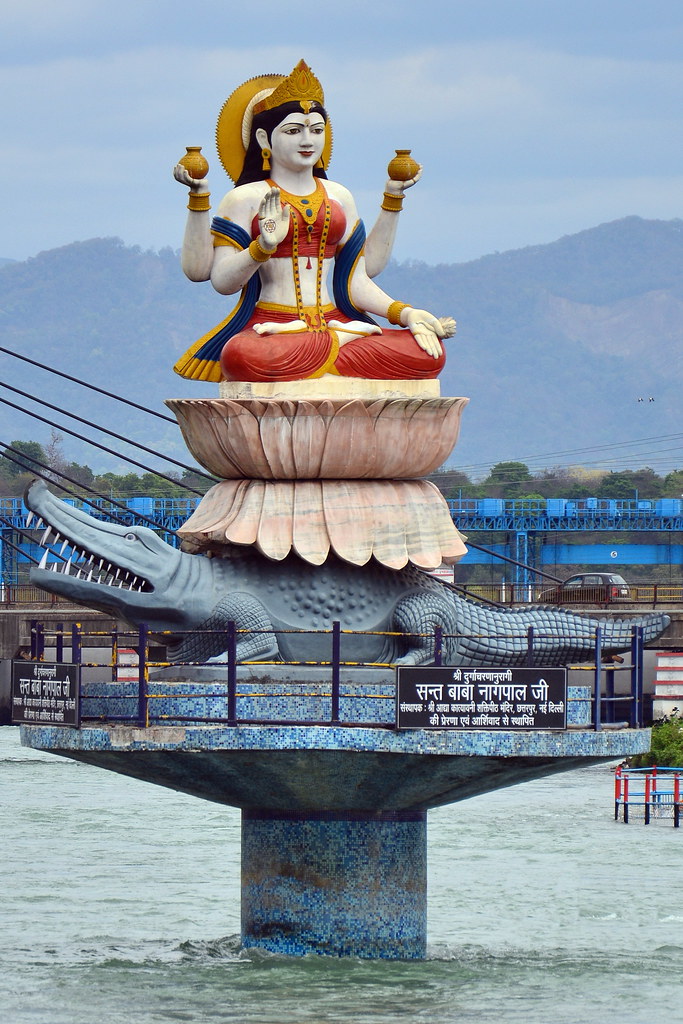
Varying myths of Ganga’s birth is found in Hindu scriptures. According to the Bhagavata Purana, Vishnu, in his incarnation as Vamana, extended his left foot to the end of the universe, and pierced a hole in its covering with the nail of his big toe. Through the hole, the pure water of the causal ocean entered this universe as the Ganges river. Having washed the lotus feet of the lord, which are covered with reddish saffron, the water of the Ganga acquired a very beautiful pink colour. Because the Ganges directly touches the lotus feet of Vishnu (Narayana) before descending within this universe, it is known as Bhagavat-Padi or Vishnupadi, which means emanating from the feet of Bhagavan (God). It finally settles in Brahmaloka or Brahmapura, the abode of the Brahma, before descending to the planet earth at the request of Bhagiratha, and held safely by Shiva on his head, to prevent the destruction of Bhumi Devi (the earth goddess). Then, Ganga was released from Shiva’s hair to meet the needs of the country.[3]
The Ramayana narrates a different version of the myth. Ganga is described as the eldest child of Himavat, son of Brahma and the king of the Himalayas, and his Menavati, the daughter of Meru. Her younger sister is Parvati, who latter marries Shiva. When Ganga attained youth, the devas took her to Svarga, where she took a form of a river and flowed.The Ganges River is considered the holiest river in Hinduism and is central to Hindu spirituality and cultural heritage:
Sacred water
The Ganges is worshipped as the goddess Ganga and is considered the most sacred body of water in Hinduism. Hindus believe that bathing in the Ganges, touching it, or naming it cleanses sins.
Salvation
Hindus believe that immersing the ashes of their dead in the Ganges, a custom known as asthi visarjan, gives the deceased direct passage to heaven and freedom from the cycle of birth and death.
Pilgrimage sites
Many places along the banks of the Ganges are considered sacred and are sites of Hindu pilgrimage, including Haridwar, Prayagraj (Allahabad), and Varanasi (Benares).
Festivals
Festivals such as Ganga Dussehra and Ganga Jayanti are celebrated at sacred sites along the Ganges.
Rituals
Many rituals are performed on the banks of the Ganges, including floating clay cradle boats, releasing aquatic life, and performing evening aartis.
Water in homes
Many Hindu families keep a vial of water from the Ganges in their homes. It is also customary to give a sip of Ganga water to someone who is dying. The Ganges, also known as the Ganga River, originates from the Bhagirathi River, which flows from Gaumukh at the base of the Gangotri Glacier in the western Himalayas of Uttarakhand, India. Gaumukh is about 13 miles (21 km) southeast of Gangotri.
The Bhagirathi and Alaknanda rivers meet at Devprayag, where the river is named the Ganga. The Ganga flows through India and Bangladesh and eventually empties into the Bay of Bengal.
The Ganga is considered the longest holy river by Hindus and is worshipped as the goddess Ganga.
A photon is a fundamental particle of light and all other forms of electromagnetic radiation. It is the quantum or discrete unit of electromagnetic energy. Photons are unique in several ways: Key Characteristics of a Photon: Energy: Photons carry energy, which is directly proportional to the frequenRead more
A photon is a fundamental particle of light and all other forms of electromagnetic radiation. It is the quantum or discrete unit of electromagnetic energy. Photons are unique in several ways:
where:
Photons are the basic units of light and electromagnetic radiation, exhibiting both particle and wave properties, and they play a crucial role in a wide range of physical phenomena.
See lessConsider the following pairs: ...Read more
Please login to vote and see the results.
Let's evaluate the pairs one by one: Cepheids: These are stars that brighten and dim periodically due to changes in their size and temperature. The description in the pair refers to stars and not to giant clouds of dust and gas. Hence, this pair is incorrect. Nebulae: Nebulae are giant clouds of dusRead more
Let’s evaluate the pairs one by one:
Therefore, only one of the pairs is correctly matched.
The answer is: Only one.
See lessWhy is the Sun at a static position and planets revolve around it??
The Sun appears static while the planets revolve around it due to the principles of gravity and inertia as explained by Newton's laws of motion and Kepler's laws of planetary motion. Here’s a detailed explanation: 1. The Sun's Gravity Holds the Planets in Orbit: The Sun has an enormous mass, makingRead more
The Sun appears static while the planets revolve around it due to the principles of gravity and inertia as explained by Newton’s laws of motion and Kepler’s laws of planetary motion. Here’s a detailed explanation:
1. The Sun’s Gravity Holds the Planets in Orbit:
The Sun has an enormous mass, making it the most massive object in the solar system.
Due to its mass, the Sun exerts a strong gravitational pull on all the planets, keeping them in orbit around it.
The force of gravity decreases with distance, so planets farther from the Sun experience a weaker gravitational pull.
2. The Balance of Gravitational Force and Inertia:
Planets are in constant motion due to their inertia (an object’s tendency to keep moving in a straight line unless acted upon by an external force).
The Sun’s gravity continuously pulls the planets towards itself, preventing them from flying off into space.
This balance between the Sun’s gravitational pull and the planets’ inertia creates a stable orbit, causing the planets to revolve around the Sun in elliptical paths.
3. Why the Sun Appears Static:
The Sun is not completely static—it also moves slightly due to the gravitational pull of the planets, particularly massive ones like Jupiter and Saturn. However, this movement is minimal compared to the planets’ orbits.
The center of mass of the solar system (the barycenter) is very close to the Sun due to its massive size, making it seem stationary relative to the planets.
4. Role of Conservation of Angular Momentum:
The solar system was formed from a rotating cloud of gas and dust. As the cloud collapsed under gravity, the conservation of angular momentum caused the planets to form in orbits around the Sun.
This rotation and conservation of angular momentum are why planets continue to revolve around the Sun instead of falling into it.
5. The Heliocentric Model:
This understanding is based on the heliocentric model, proposed by Nicolaus Copernicus and later supported by Galileo and Kepler, which places the Sun at the center of the solar system.
In summary, the combination of the Sun’s gravitational force, the planets’ inertia, and the principles of angular momentum explains why the Sun remains at a relatively static position while planets revolve around it.
See lessWhat are grap restrictions?
GRAP Stage 3 entails a ban on non-essential construction work. Classes up to grade V are required to shift to hybrid mode under Stage 3. Parents and students have the option to choose online education wherever available. Under Stage 3, the use of BS-III petrol and BS-IV diesel cars (4-wheelers) is rRead more
GRAP Stage 3 entails a ban on non-essential construction work. Classes up to grade V are required to shift to hybrid mode under Stage 3. Parents and students have the option to choose online education wherever available.
Under Stage 3, the use of BS-III petrol and BS-IV diesel cars (4-wheelers) is restricted in Delhi and nearby NCR districts. Persons with disabilities are exempt.
Stage 3 also bans non-essential diesel-operated medium goods vehicles with BS-IV or older standards in Delhi. The Stage 3 of GRAP was lifted on December 27 after a marked improvement in Delhi’s air quality following day-long rainfall in the national capital.
Throughout 2024, Delhi recorded the highest number of ‘severe’ AQI days since 2022, with 17 days exceeding an AQI of 400. Additionally, 70 days were classified as ‘very poor’. Not a single ‘good’ air quality day was recorded in 2024, a first since 2018.
See lessA solar eclipse occurs when the Moon passes between the Earth and the Sun, blocking the Sun's light either partially or completely for a short period. This phenomenon can only take place during a new moon, when the Sun, Moon, and Earth align in a straight or nearly straight line, a condition known aRead more
A solar eclipse occurs when the Moon passes between the Earth and the Sun, blocking the Sun’s light either partially or completely for a short period. This phenomenon can only take place during a new moon, when the Sun, Moon, and Earth align in a straight or nearly straight line, a condition known as syzygy.
Never look directly at the Sun during a solar eclipse without proper eye protection, such as solar viewing glasses, as it can cause permanent eye damage.
Solar eclipses are fascinating celestial events that have been observed and studied throughout history, often sparking cultural and scientific interest.
See less
Introduction: 10 most powerful bows In the modern world, we look to particle accelerators and nuclear payloads to define the limits of destructive power. But thousands of years ago, the thinkers of the Indian subcontinent conceptualized a terrifyingly advanced form ...
The Ken-Betwa Link Project (KBLP) is no longer just a blueprint on a map; it is a massive, active engineering reality that serves as the vanguard for India’s National Perspective Plan (NPP) for inter-basin water transfer. Aimed at ending the ...
Patriot vs Nationalist: Introduction The words patriot and nationalist are often used as if they mean the same thing. Both express a strong connection to one’s country, both evoke pride, and both can inspire people to act in the name ...
Introduction: The Eternal Hymn of Detachment and Devotion Shiv Rudrashtakam is one of the most profound Sanskrit hymns dedicated to Lord Shiva, the supreme yogi, destroyer of ignorance, and embodiment of pure consciousness. Composed by Adi Shankaracharya, this eight-verse stotra ...
A Prime-Adam Number is defined as a positive number that fulfills two conditions simultaneously: it is a prime number and also an Adam number. For example, take the number 13; its reverse is 31. The square of 13 is 169, and the ...
Introduction The 74th Miss Universe pageant, held on November 21, 2025, at the Impact Challenger Hall in Nonthaburi, Thailand, set a new benchmark in global beauty contests. Not merely a showcase of beauty and fashion, this year’s event stood as ...
Sterilization refers to actions taken by the central bank (in this case, the Reserve Bank of India) to manage the impact of foreign capital flows on the domestic money supply. Open Market Operations (OMOs) are one such tool where the central bank buys or sells government securities in the open markeRead more
Sterilization refers to actions taken by the central bank (in this case, the Reserve Bank of India) to manage the impact of foreign capital flows on the domestic money supply. Open Market Operations (OMOs) are one such tool where the central bank buys or sells government securities in the open market to influence liquidity and control inflation or currency appreciation/depreciation. This process helps in managing the domestic monetary base without affecting other macroeconomic variables. Therefore, the correct answer is Conducting ‘Open Market Operations’.
See less