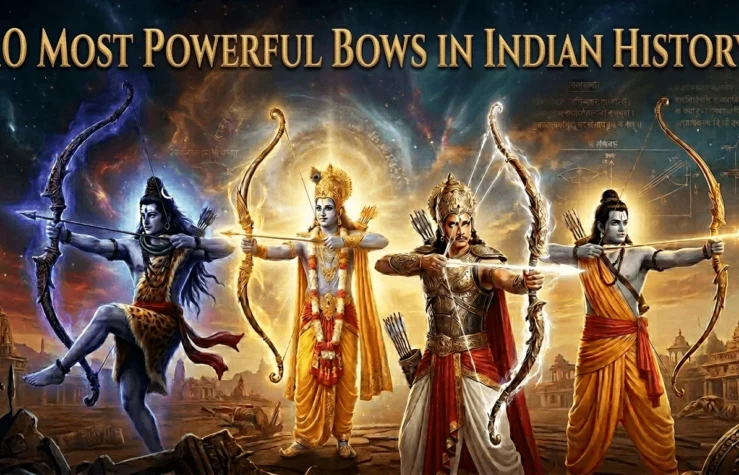
Introduction: 10 most powerful bows
In the modern world, we look to particle accelerators and nuclear payloads to define the limits of destructive power. But thousands of years ago, the thinkers of the Indian subcontinent conceptualized a terrifyingly advanced form of warfare.
In the sacred epics (Itihasa) of the Ramayana and Mahabharata, the ultimate martial science was Dhanurveda—the science of archery. Yet, the legendary bows wielded by gods and god-kings were not merely wood and sinew. They were sentient, macro-engineered instruments capable of warping space, channeling cosmic energy, and launching astras (guided celestial weapons) that mirror modern ballistic and thermonuclear capabilities.
To understand how ancient India viewed the intersection of weapons technology and spiritual mastery, we look at the ten most powerful bows of Indian tradition, ranked from formidable battlefield weapons to instruments of total cosmic collapse.
The Battlefield Tier: Advanced Terrestrial & Illusionary Warfare
These weapons dominated the material battlefield, utilizing advanced cloaking, mass-multiplication, and elemental energy.
10. The Asura Bow – Ravana’s Demonic Arsenal
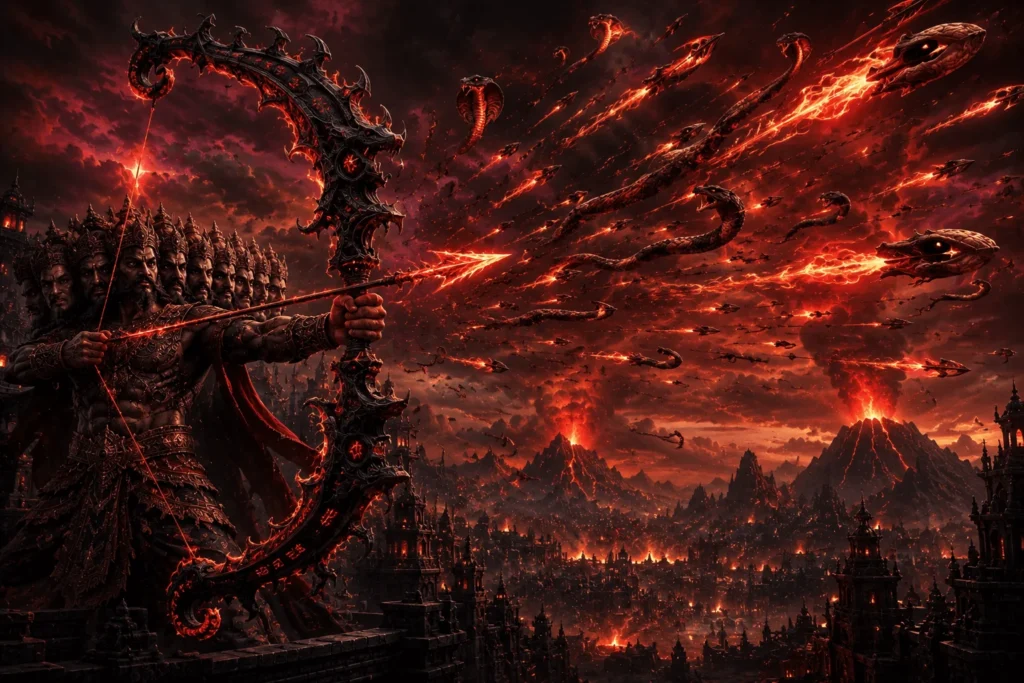
The Asura Bow represents the pinnacle of demonic warfare in the Ramayana tradition. Unlike conventional bows that rely on accuracy and penetration, this weapon specialized in overwhelming opponents through chaos and fear. Crafted through powerful Mayavi Vidya (sorcery and illusion), the bow transformed a single projectile into countless manifestations.
When released, an arrow could multiply into showers of fire, poisonous serpents, jagged shards of metal, or terrifying illusions designed to break enemy morale. Entire formations could be disrupted before physical contact even occurred. The weapon symbolized Ravana’s preference for psychological dominance and overwhelming force. More than a battlefield weapon, the Asura Bow embodied the philosophy of the Rakshasas—power without restraint. Its destructive potential was immense, but ultimately it lacked the divine purity that characterized the higher-ranked celestial bows.
Associated Wielder: Ravana
Special Ability: Multiplication and transformation of projectiles
Symbolism: Fear, illusion, and psychological warfare
9. Paulastya – Meghanada’s Cloaked Striker
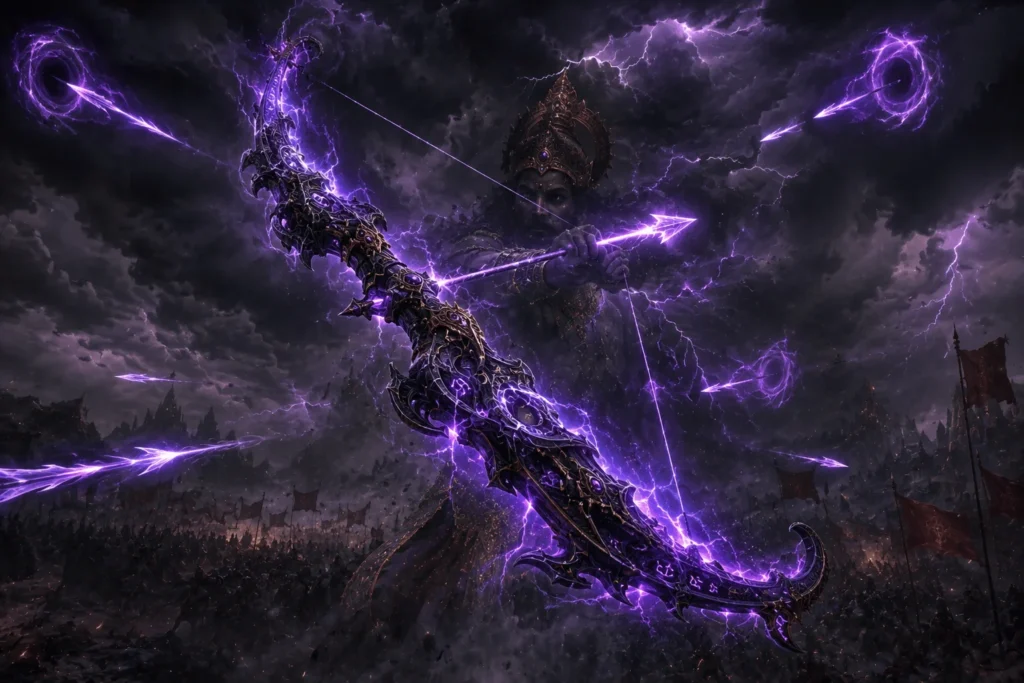
Named after the sage Pulastya, ancestor of Ravana’s lineage, the Paulastya Bow was the ultimate weapon of stealth warfare. It gained fame through Meghanada (Indrajit), one of the most formidable warriors of the Ramayana. Unlike traditional bows that relied on direct engagement, Paulastya excelled in concealment and surprise attacks. Meghanada often fought while hidden behind magical cloud formations or protected by illusionary barriers. The bow allowed him to strike from unseen locations, making it nearly impossible for enemies to identify the source of incoming attacks.
Its greatest strength was unpredictability. Entire armies could be immobilized before they even understood who was attacking them. The Paulastya transformed warfare from a visible contest of strength into a deadly game of invisibility and deception.
Associated Wielder: Meghanada (Indrajit)
Special Ability: Invisible attacks and stealth combat
Symbolism: Strategy, deception, and tactical superiority
8. Raudra – The Bow of Rudra’s Fury
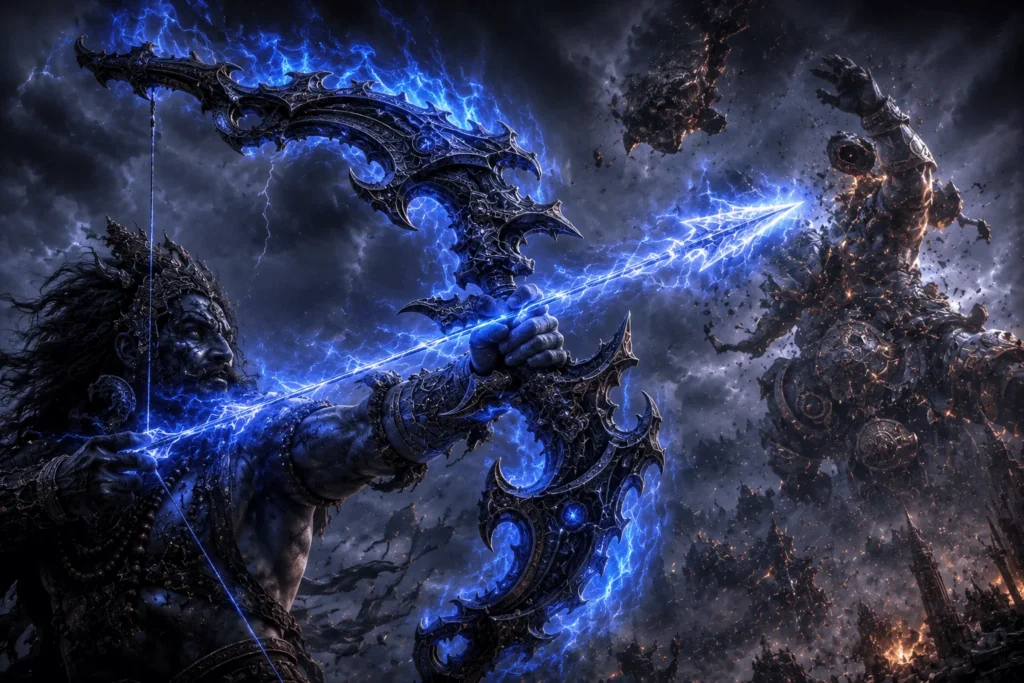
The Raudra Bow drew its power from the fierce Rudra aspect of Lord Shiva. It was designed for concentrated destruction rather than widespread devastation. Its arrows possessed exceptional penetrating power, capable of piercing armor that would otherwise be impervious to ordinary weapons. The bow’s energy was focused into singular, devastating strikes intended to eliminate powerful opponents rather than entire armies.
The Raudra reflected Shiva’s destructive aspect—not the destruction of worlds, but the destruction of obstacles. Every shot carried immense force and precision. Though its battlefield impact was narrower than higher-ranked bows, few weapons could match its raw armor-piercing capability.
Associated Wielder: Rukmi
Special Ability: Extreme penetration and concentrated force
Symbolism: Controlled destruction and martial power
7. Mahendra – Indra’s Storm Bow
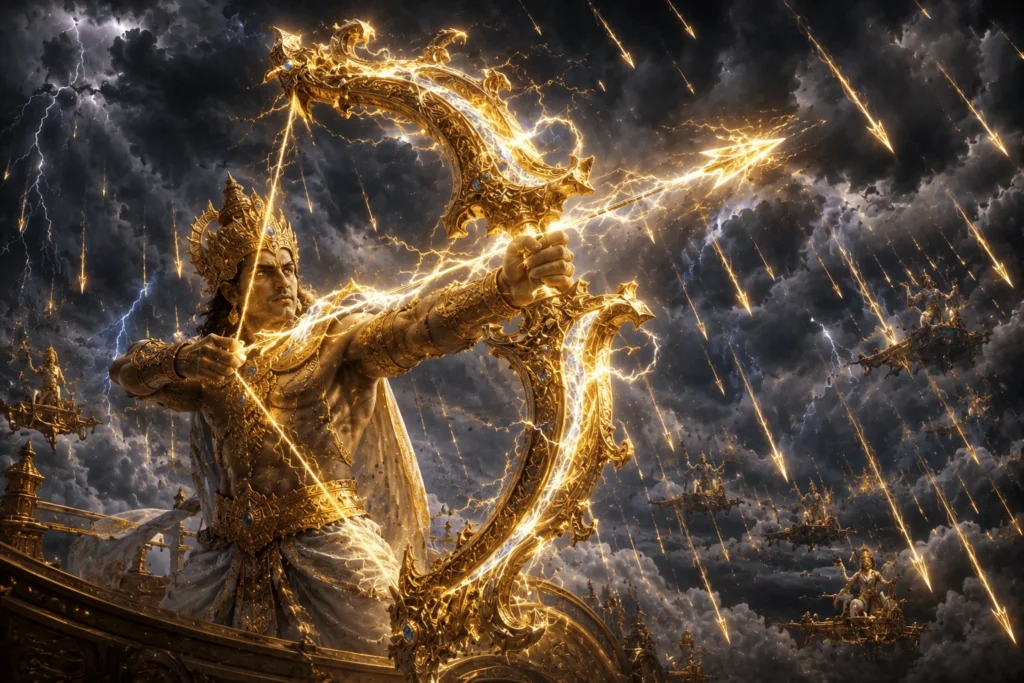
The Mahendra Bow belonged to Lord Indra, king of the Devas and ruler of the heavens. As expected from the lord of storms, the weapon was deeply connected to atmospheric forces. The bow could summon lightning, thunder, torrential rain, and violent winds. Every arrow carried the power of a storm, transforming the battlefield into a raging tempest. Rather than targeting individual enemies, Mahendra altered the environment itself.
Its volleys resembled celestial artillery bombardments. Armies faced not merely arrows but nature’s fury unleashed through divine will. The weapon reflected Indra’s role as protector of heaven and controller of cosmic weather.
Associated Wielder: Lord Indra
Special Ability: Weather manipulation and lightning warfare
Symbolism: Authority, kingship, and elemental power
6. Govardhana – The Bow That Never Fought
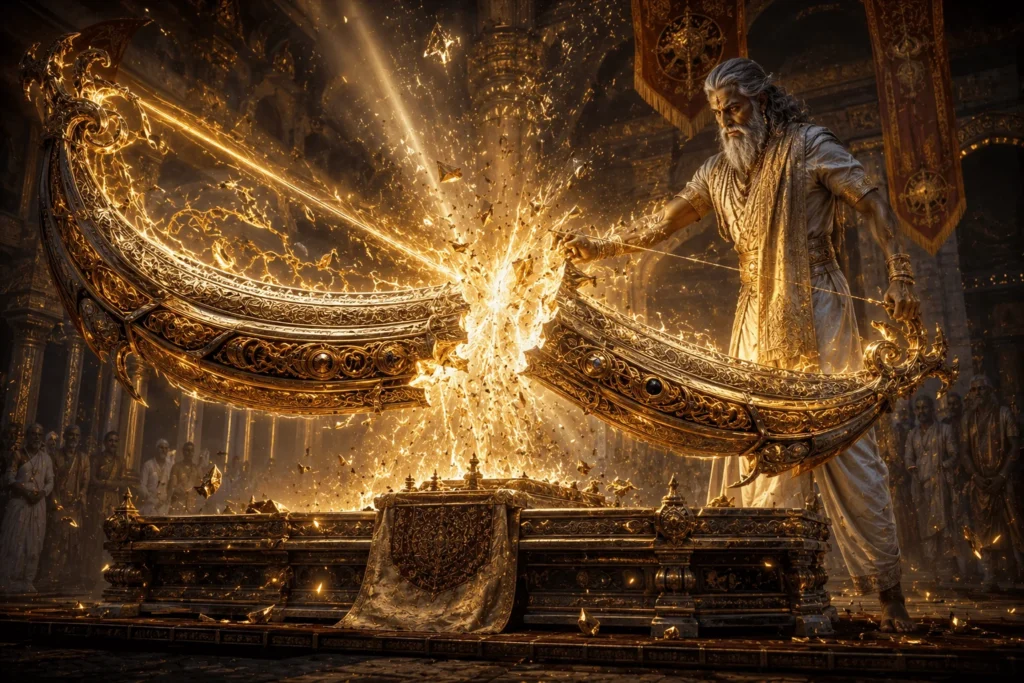
The Govardhana Bow occupies a unique place among legendary weapons because its greatest achievement was never being used. Created alongside the Gandiva, it possessed nearly identical power and divine craftsmanship. Yet its owner, Vidura, was renowned not for martial skill but for wisdom, morality, and restraint.
Recognizing that his participation in the Kurukshetra War could alter destiny itself, Vidura chose neutrality. According to tradition, he broke the bow rather than allow its power to influence the conflict. This act transformed Govardhana into a symbol of self-control. It demonstrated that true strength sometimes lies not in using power, but in willingly surrendering it.
Associated Wielder: Vidura
Special Ability: Equal power to Gandiva
Symbolism: Wisdom, restraint, and sacrifice
5. Kodanda – Rama’s Bow of Perfect Precision
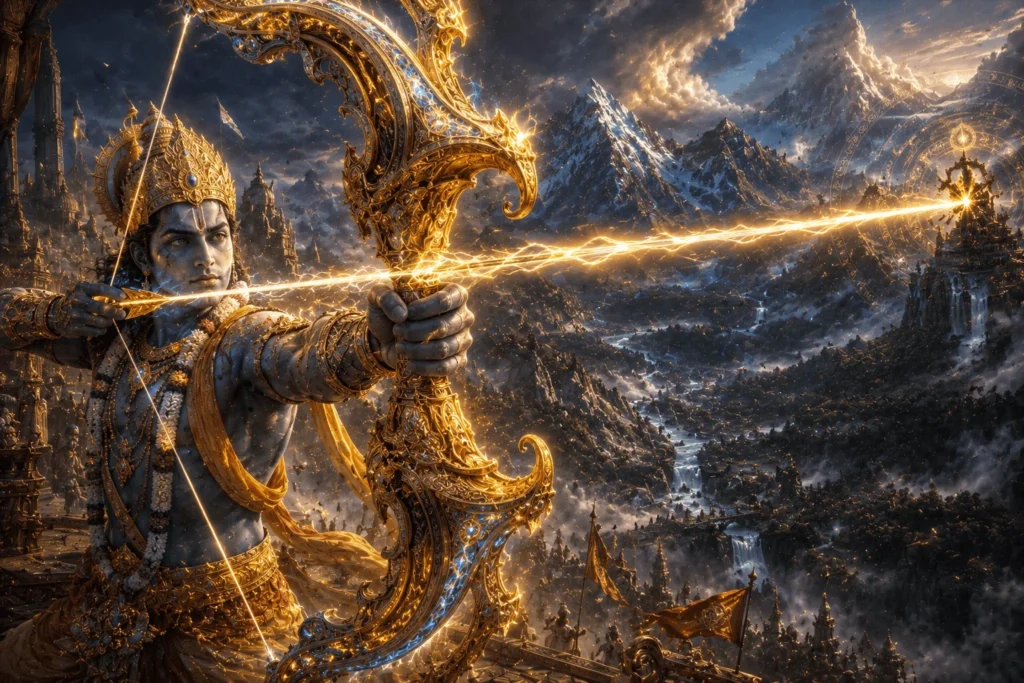
Among all divine bows, Kodanda is perhaps the most elegant. It lacked the overwhelming complexity of other celestial weapons, yet it achieved perfection through simplicity. In the hands of Lord Rama, Kodanda became the embodiment of Dharma. Every arrow found its intended target. No illusion, obstacle, magical defense, or distance could divert its course.
Unlike weapons designed for destruction, Kodanda existed to restore balance and justice. It represented focused intent guided by righteousness. Its power lay not in volume of fire, but in flawless execution. The bow perfectly reflected Rama himself—disciplined, unwavering, and incapable of error when acting in accordance with Dharma.
Associated Wielder: Lord Rama
Special Ability: Absolute accuracy
Symbolism: Dharma, justice, and perfection
4. Gandiva – Arjuna’s Infinite Engine of War
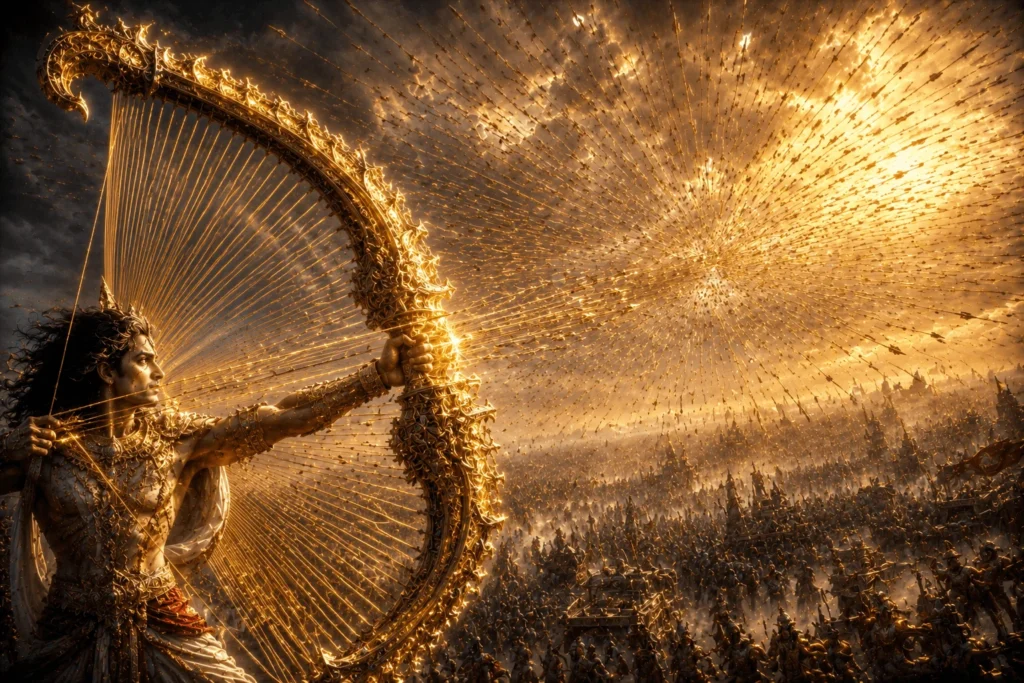
The Gandiva is arguably the most famous bow in Indian mythology. Forged by divine powers and entrusted to Arjuna, it played a central role in the Mahabharata. The bow possessed extraordinary characteristics. Its strings never broke, its energy never diminished, and its arrows could be released at unimaginable speed. When drawn, it produced a thunderous sound that echoed across battlefields.
Under Arjuna’s mastery, Gandiva became a force multiplier unlike any other weapon. He could unleash such dense barrages that sunlight itself disappeared behind walls of arrows. Combined with celestial astras and Arjuna’s unparalleled skill, Gandiva became one of the deadliest weapons ever wielded by a human warrior.
Associated Wielder: Arjuna
Special Ability: Infinite endurance and rapid-fire capability
Symbolism: Heroism, mastery, and divine warfare
3. Vijaya – Karna’s Invincible Bow
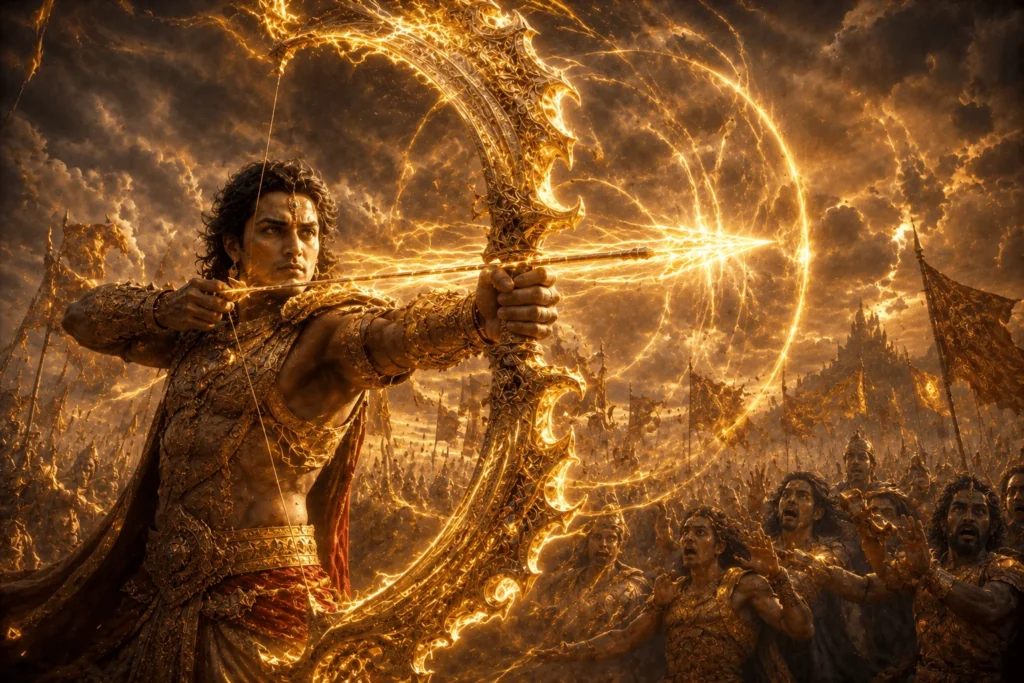
The Vijaya Bow was crafted by the divine architect Vishvakarma for Lord Shiva before eventually coming into Karna’s possession. Its very name means “Victory.” Every time the bowstring was drawn, it generated an overwhelming resonance that struck fear into enemies. The weapon amplified both the physical and spiritual presence of its wielder.
Unlike most bows, Vijaya functioned as both weapon and shield. Ancient descriptions portray it as making its wielder nearly impossible to defeat while actively engaged in combat. For Karna, the bow symbolized destiny, greatness, and tragic heroism. Even among divine weapons, Vijaya stood apart as an instrument of unstoppable martial supremacy.
Associated Wielder: Karna
Special Ability: Defensive aura and battlefield domination
Symbolism: Victory, honor, and destiny
2. Sharanga – Vishnu’s Bow of Preservation
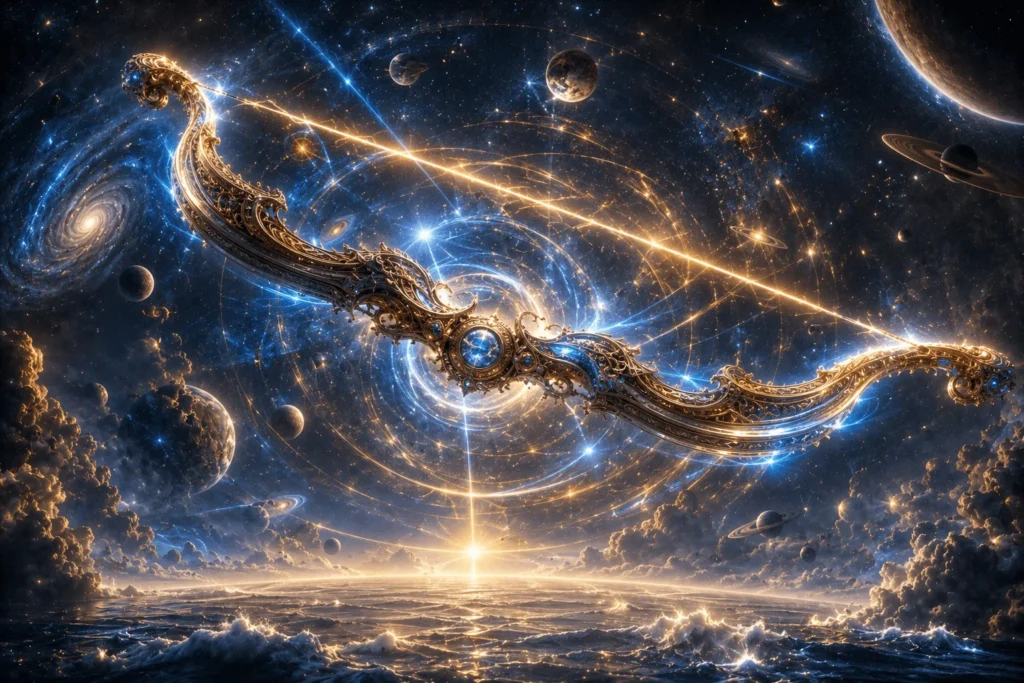
Sharanga belongs to Lord Vishnu, the cosmic preserver responsible for maintaining universal order. Unlike bows associated with destruction, Sharanga represents stability and balance. Its power exists not to annihilate existence but to protect it. The weapon channels the sustaining energy of the cosmos itself.
The vibration of its bowstring is said to reverberate through the universe, shaking planets and terrifying forces of chaos. Even before an arrow is released, enemies recognize the overwhelming authority of Vishnu’s presence. Sharanga embodies the principle that preservation is often more powerful than destruction. Through it, Vishnu safeguards cosmic harmony.
Associated Wielder: Lord Vishnu
Special Ability: Universal energy manipulation
Symbolism: Preservation, balance, and cosmic order
1. Pinaka – Shiva’s Bow of Cosmic Dissolution
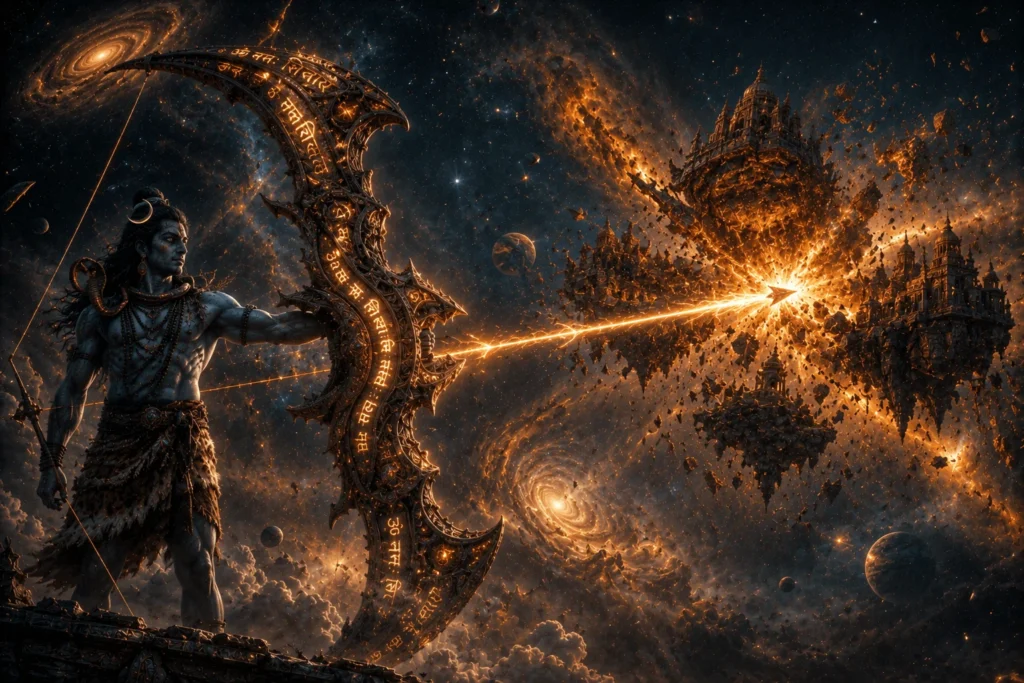
At the summit of all legendary bows stands Pinaka, the personal weapon of Lord Shiva. Pinaka transcends the concept of warfare. It is not merely a weapon but a manifestation of Shiva’s role as destroyer and transformer of the universe. The bow embodies Pralaya—the cosmic dissolution that ends one cycle of creation and prepares the way for another. Its most famous feat was the destruction of Tripura, the three seemingly invincible cities of the Tripurasuras. With a single arrow, Shiva reduced these mighty strongholds to ashes.
The bow’s immense power is further emphasized by its role in the Ramayana, where even moving it required extraordinary effort. When Lord Rama eventually lifted and strung it, the resulting force shattered the bow itself. Pinaka symbolizes absolute power, cosmic transformation, and the inevitability of change. No other bow in Indian mythology approaches its scale or significance.
Associated Wielder: Lord Shiva
Special Ability: Cosmic destruction and universal transformation
Symbolism: Pralaya, transcendence, and divine power
The bow was so saturated with cosmic gravity that when it was placed on Earth in the kingdom of Janaka, it could not be lifted by mortal men. It required a massive, reinforced iron cart resting on eight wheels, dragged by a force of over 300 men, just to transport it. When Lord Rama eventually lifted and strung it, the sheer tensile energy of the bow caused it to snap, sending a shockwave that reportedly echoed across the three worlds.
The Mind as The Ultimate String
To the ancient philosophers of India, physics and consciousness were deeply intertwined. Dhanurveda dictates that a bow is ultimately just a conduit. The true explosive yield did not come from the celestial metal or the golden strings, but from the archer’s mind. A warrior with absolute spiritual realization could weaponize a simple blade of grass to unleash the power of a universe; the bow was merely the lens that focused that infinite consciousness into a single, terrifying point.