The Ken-Betwa Link Project (KBLP) is no longer just a blueprint on a map; it is a massive, active engineering reality that serves as the vanguard for India’s National Perspective Plan (NPP) for inter-basin water transfer. Aimed at ending the perpetual drought cycles in the Bundelkhand region, the project represents a ₹44,605 crore investment in regional socio-economic transformation.
Following the laying of the foundation stone by Prime Minister Narendra Modi on December 25, 2024, the project has moved into a high-stakes implementation phase, scheduled for completion by March 2030. However, as of April 2026, the project has become a flashpoint for intense social protests and rigorous scientific debate over its long-term ecological viability.
Ken-Betwa Link Project: Project Overview
The core mission of the KBLP is to transfer “surplus” water from the Ken River in Madhya Pradesh to the water-deficit Betwa River in Uttar Pradesh. Both rivers are key tributaries of the Yamuna, but they possess vastly different hydrological profiles.
Strategic Objectives
- Irrigation Expansion: Providing annual irrigation to 10.62 lakh hectares of land (8.11 lakh ha in MP and 2.51 lakh ha in UP) .
- Drinking Water Security: Supplying potable water to approximately 62 lakh people across 13 districts .
- Renewable Energy: Generating 103 MW of hydropower and 27 MW of solar power .
- Socio-Economic Relief: Mitigating distress migration and reducing farmer suicide rates in the drought-prone Bundelkhand region.
Engineering Architecture: Phase I and Phase II
The project is being executed in two distinct phases to manage the technical and administrative complexities.
Phase I: The Daudhan Dam Complex
The centerpiece of the project is the Daudhan Dam, located on the Ken River within the Chhatarpur district of Madhya Pradesh.
- Structure: A composite dam standing 77 meters high and spanning 2,031 meters in length .
- Reservoir: A storage capacity of 2,853 million cubic meters (MCM) at a full reservoir level (FRL) of 288 meters .
- Link Canal: A 221 km long canal, including a specialized 2 km tunnel section, to transport water from the Ken to the Betwa .
Phase II: Sub-Basin Infrastructure
Phase II focuses on utilizing transferred water through three major components in the Betwa basin:
- Lower Orr Dam: A 45-meter-high dam designed to irrigate 90,000 hectares in the Shivpuri and Datia districts .
- Bina Complex Multipurpose Project: Includes four dams (Madia, Semra Ghat, Dehra, and Chakarpur) to irrigate 96,000 hectares in the Sagar district .
- Kotha Barrage: A 16.5-meter-high structure on the junction of the Betwa and Keotan rivers, utilizing pressurized micro-irrigation for 20,000 hectares .
Current Situation (April 2026): Protests and Social Unrest
As of mid-April 2026, the project has entered a period of significant social turbulence. Tribal communities, primarily the Gond and Kol tribes, have launched intense movements against perceived failures in rehabilitation and compensation .
The “Panch Tatva Satyagraha”
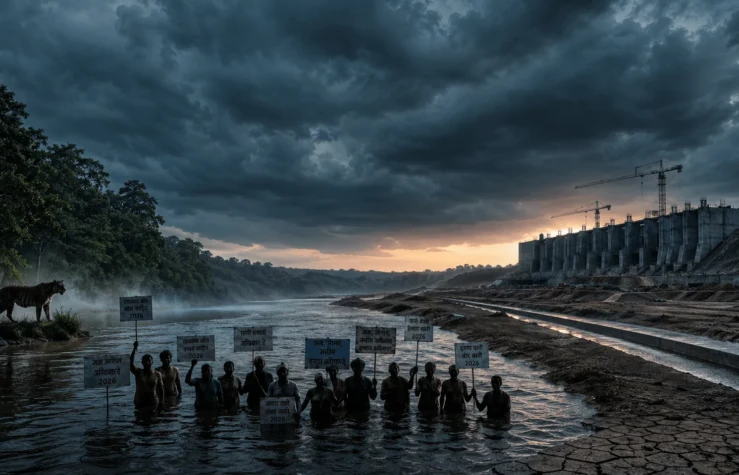
Between April 5 and April 16, 2026, protesters in the village of Dhodhan and surrounding areas engaged in several symbolic acts of resistance :
- Chita Andolan: Protesters lying on symbolic funeral pyres to signify the “death” of their livelihoods.
- Akash Andolan: Mass fasting to demand the recognition of adult family members in compensation surveys.
- Mitti Andolan: Smearing soil on their bodies to emphasize their connection to the land.
- Jal Andolan: Entering the river with nooses around their necks to demand justice or death.
On April 16, 2026, the local administration agreed to a 10-day extension to conduct fresh, door-to-door surveys to resolve compensation discrepancies, after reports emerged of families being offered as little as ₹16 to ₹200 for their homes.
Ecological Crisis: The Panna Tiger Reserve Controversy
The project’s environmental footprint is one of the most debated in modern Indian history. The construction of the Daudhan Dam will result in the submergence of 9,000 hectares, of which 5,258 hectares is forest land .
- Critical Habitat Loss: Approximately 6,017 hectares of the Panna Tiger Reserve (PTR)—nearly 10% of its core and buffer areas—will be submerged or diverted .
- Mass Deforestation: Estimates for the number of trees to be felled range from 2.3 million to as many as 6 million .
- Species at Risk: Beyond tigers, the project threatens the Ken Gharial Sanctuary and critical vulture nesting sites downstream .
In response, the Wildlife Institute of India (WII) is finalizing a Comprehensive Landscape Management Plan (CLMP) to integrate neighboring forest divisions to offset these losses .
Scientific Scrutiny: The Rainfall Deficit Warning
A significant scientific red flag was raised by researchers at IIT-Bombay, who warned of “land-atmosphere feedback” disruptions. Their study suggests that moving massive quantities of water for irrigation could alter regional soil moisture patterns, potentially leading to a 12% reduction in September rainfall in the already water-stressed Bundelkhand region . This late-monsoon rainfall is vital for post-monsoon crop survival and river replenishment .
Legal and Funding Snapshot
The KBLP is a “National Project,” with the Central Government providing approximately 90% of the funding (₹39,317 crore) . It is managed by the Ken Betwa Link Project Authority (KBLPA), a Special Purpose Vehicle (SPV) .
Despite its progress, the project still faces legal hurdles:
- Supreme Court CEC: A 2019 report by the Central Empowered Committee (CEC) questioned the wildlife clearance, deeming it “illegal” under the Wildlife Protection Act, 1972.
- NGT Status: Challenges to the environmental clearance remain pending before the National Green Tribunal (NGT) .
Conclusion: A High-Stakes Vision for 2030
The Ken-Betwa Link Project is a bold attempt to re-engineer the hydrological destiny of Central India. While it promises water security to millions and a permanent solution to Bundelkhand’s agrarian distress, it must navigate the immediate crises of 2026—namely, the fair rehabilitation of its tribal citizens and the mitigation of irreversible damage to the Panna Tiger Reserve. The success of this inaugural project will dictate the future of 29 other river-interlinking ventures across the nation.