


What is the significance of the law of conservation of mass?

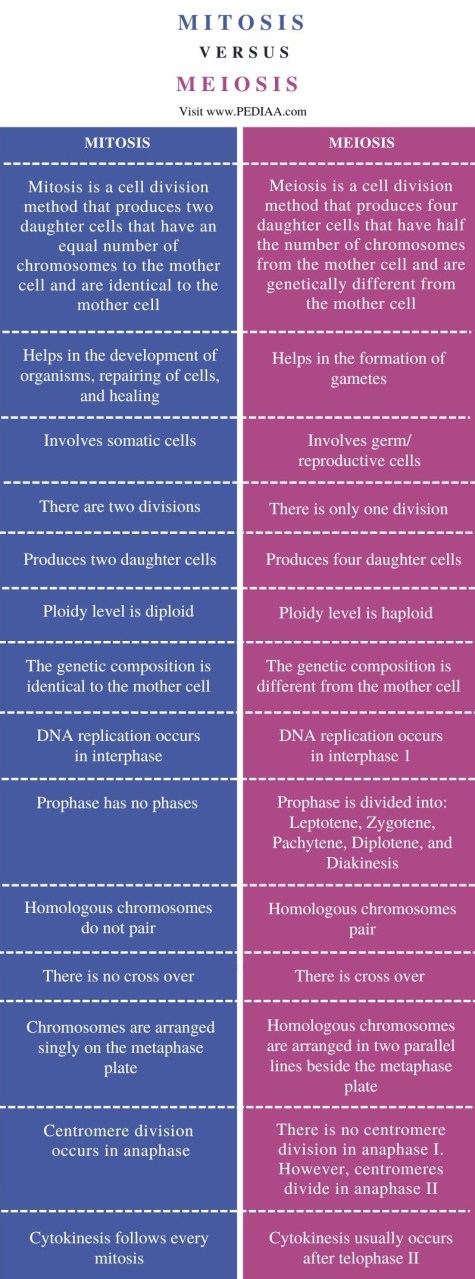
Mitosis and meiosis are both cell division processes, but they differ in several ways, including: Number of daughter cells Mitosis produces two identical daughter cells, while meiosis produces four unique daughter cells. Number of chromosomes Mitosis produces daughter cells with the same number of cRead more
Mitosis and meiosis are both cell division processes, but they differ in several ways, including:
Number of daughter cells
Mitosis produces two identical daughter cells, while meiosis produces four unique daughter cells.
Number of chromosomes
Mitosis produces daughter cells with the same number of chromosomes as the parent cell, while meiosis produces daughter cells with half the number of chromosomes as the parent cell.
Purpose
Mitosis is used for growth, repair, and replacement of cells, while meiosis is used to produce gametes (sperm and eggs).
Chromosome alignment
In mitosis, sister chromatids align at the metaphase plate, while in meiosis, homologous chromosome pairs align at the metaphase plate.
Prophase
Prophase I in meiosis has five stages and lasts longer than prophase in mitosis.
Health issues
Uncontrolled mitosis can lead to cancer, while errors in meiosis can lead to aneuploidy, which can cause miscarriage or syndromes like Down’s syndrome and Klinefelter syndrome.









The law of conservation of mass is significant because it helped scientists understand that matter is not created or destroyed during chemical reactions, but rather transformed into other substances with the same mass. This discovery was a key factor in the progression of chemistry and the developmeRead more
The law of conservation of mass is significant because it helped scientists understand that matter is not created or destroyed during chemical reactions, but rather transformed into other substances with the same mass. This discovery was a key factor in the progression of chemistry and the development of modern science.
See lessHere are some other details about the law of conservation of mass:
Explanation
The law states that the total mass of all reactants and products in a chemical reaction is the same at any point in time. This is because mass can be rearranged in space and the entities associated with it can change shape.
Discovery
The law was discovered by multiple scientists, including Russian scientist Mikhail Lomonosov and French chemist Antoine Lavoisier. Lavoisier is sometimes credited with discovering the law, and it is sometimes known as Lavoisier’s Law.
Chemical equations
A balanced chemical equation satisfies the law of conservation of mass. In a balanced chemical equation, the number of each type of atom is the same on both sides of the equation.
Physical changes
The law of conservation of mass does not apply to physical changes, such as ice melting to water. In a physical change, the physical properties of a substance change, but its chemical identity remains the same.