
Sign Up

Sign up to our innovative Q&A platform to pose your queries, share your wisdom, and engage with a community of inquisitive minds.

Have an account? Sign In
Continue with Facebook
Continue with Google
Continue with X
or use


Have an account? Sign In Now

Sign In

Log in to our dynamic platform to ask insightful questions, provide valuable answers, and connect with a vibrant community of curious minds.

Sign Up Here
Continue with Facebook
Continue with Google
Continue with X
or use


Forgot Password?

Don't have account, Sign Up Here

Forgot Password

Forgot your password? No worries, we're here to help! Simply enter your email address, and we'll send you a link. Click the link, and you'll receive another email with a temporary password. Use that password to log in and set up your new one!


Have an account? Sign In Now

Please briefly explain why you feel this question should be reported.

Please briefly explain why you feel this answer should be reported.

Please briefly explain why you feel this user should be reported.

Sign InSign Up

Qukut

Qukut Logo Qukut Logo

Qukut Navigation

  • Home
  • Blog
  • About Us
  • Contact Us
Search
Ask A Question

Mobile menu

Close
Ask A Question
  • Home
  • Blog
  • About Us
  • Contact Us
  • Questions
  • FAQs
  • Points & Badges
  • Qukut LMS
Home/Questions/Page 32

Qukut Latest Questions

Jawahar
  • 0
JawaharExplorer
Asked: 1 year agoIn: Science

What is the theory behind the origin of life on Earth?

  • 0

What is the theory behind the origin of life on Earth?

What is the theory behind the origin of life on Earth?

Read less
1
  • 1 1 Answer
  • 7 Views
  • 0 Followers
Answer
  1. Nitin
    Nitin Beginner
    Added an answer about 1 year ago

    The origin of life on Earth has fascinated scientists for centuries, and several theories attempt to explain how life began. These theories combine knowledge from biology, chemistry, and geology. Below are the most prominent theories regarding the origin of life: 1. Primordial Soup Hypothesis ProposRead more

    The origin of life on Earth has fascinated scientists for centuries, and several theories attempt to explain how life began. These theories combine knowledge from biology, chemistry, and geology. Below are the most prominent theories regarding the origin of life:

    1. Primordial Soup Hypothesis

    • Proposed by Alexander Oparin and J.B.S. Haldane, this theory suggests that life began in a “soup” of organic molecules in Earth’s early oceans.
    • The Earth’s early atmosphere, rich in methane, ammonia, hydrogen, and water vapor, was thought to be conducive to chemical reactions driven by energy sources like lightning, UV radiation, or volcanic activity.
    • Organic molecules, like amino acids and nucleotides, formed in this environment, eventually combining to create more complex molecules like proteins and nucleic acids.

    2. Miller-Urey Experiment

    • In 1953, Stanley Miller and Harold Urey conducted an experiment that supported the primordial soup hypothesis.
    • By simulating early Earth conditions, they demonstrated that amino acids and other organic molecules could form spontaneously under the right conditions.

    3. Deep-Sea Hydrothermal Vent Hypothesis

    • This theory posits that life originated near hydrothermal vents on the ocean floor.
    • These vents release heat and chemicals, creating a stable environment for complex chemical reactions.
    • Minerals in the vents may have acted as catalysts, aiding the formation of organic molecules and early metabolic systems.

    4. Panspermia Hypothesis

    • Suggests that life, or the building blocks of life, originated elsewhere in the universe and were delivered to Earth via comets, asteroids, or meteorites.
    • Evidence supporting this includes the discovery of amino acids and other organic compounds in meteorites.

    5. RNA World Hypothesis

    • Proposes that RNA molecules were the first self-replicating systems capable of storing genetic information and catalyzing chemical reactions.
    • RNA’s dual role as both genetic material and a catalyst supports its central role in the early stages of life.
    • Over time, RNA-based systems may have evolved into more complex DNA-protein-based life.

    6. Metabolism-First Hypothesis

    • Suggests that simple metabolic networks formed before genetic material like RNA or DNA.
    • Chemical reactions in early Earth environments could have produced energy and small molecules, forming the foundation for life.

    7. Clay Hypothesis

    • Proposed by Graham Cairns-Smith, this theory argues that life may have started on the surfaces of clay minerals.
    • Clay provides a surface for organic molecules to concentrate and interact, potentially leading to the formation of complex structures.

    Key Factors Supporting Life’s Origin

    • Early Earth Conditions: The Earth, about 4 billion years ago, had the right combination of water, heat, and essential chemical elements.
    • Energy Sources: UV radiation, volcanic activity, and lightning provided energy for chemical reactions.
    • Time: Billions of years allowed for gradual chemical evolution leading to the first simple life forms.

    Unsolved Questions

    • How did the first cell membranes form?
    • How did the transition from non-living to living systems occur?
    • How did early metabolic pathways evolve?

    While no single theory fully explains the origin of life, these hypotheses collectively provide a framework for understanding how life may have emerged on Earth. Ongoing research continues to explore this profound mystery

    See less
      • 0
    • Share
      Share
      • Share on Facebook
      • Share on Twitter
      • Share on LinkedIn
      • Share on WhatsApp
Jawahar
  • 0
JawaharExplorer
Asked: 1 year agoIn: Science

How does a magnetic field work?

  • 0

How does a magnetic field work?

How does a magnetic field work?

Read less
1
  • 1 1 Answer
  • 12 Views
  • 0 Followers
Answer
  1. Pankaj Gupta
    Pankaj Gupta Scholar
    Added an answer about 1 year ago

    A magnetic field is a region of space where a magnetic force can be detected. It is created by moving electric charges or inherent magnetic properties of materials. Here’s a detailed breakdown of how a magnetic field works: 1. Origin of Magnetic Fields Moving Electric Charges: Magnetic fields are prRead more

    A magnetic field is a region of space where a magnetic force can be detected. It is created by moving electric charges or inherent magnetic properties of materials. Here’s a detailed breakdown of how a magnetic field works:

    1. Origin of Magnetic Fields

    • Moving Electric Charges: Magnetic fields are produced whenever electric charges move. For example:
      • A current flowing through a wire generates a circular magnetic field around the wire.
    • Magnetic Materials: In materials like iron, certain atomic particles (electrons) have magnetic moments. When these moments align in the same direction, the material itself becomes a source of a magnetic field.

    2. Representation of Magnetic Fields

    • Field Lines: Magnetic fields are visually represented using magnetic field lines.
      • These lines flow from the north pole to the south pole outside a magnet.
      • Inside the magnet, the lines continue from the south pole back to the north pole, forming closed loops.
    • Direction and Strength:
      • The direction of the magnetic field is the direction a north pole of a compass needle points when placed in the field.
      • The strength of the field is indicated by the density of the field lines; closer lines mean a stronger field.

    3. Magnetic Force

    A magnetic field exerts forces on:

    • Other Magnetic Objects: It can attract or repel other magnets depending on the alignment of their poles.
    • Moving Charges: A moving charged particle (like an electron) in a magnetic field experiences a force perpendicular to both its velocity and the magnetic field (Lorentz force).

    4. Mathematical Description

    • Magnetic Field (B):
      • Represented as a vector field.
      • Measured in teslas (T) in the SI unit system.
    • Biot-Savart Law: Describes how currents produce magnetic fields.
    • Ampere’s Law: Relates the integrated magnetic field around a closed loop to the electric current passing through the loop.

    5. Applications of Magnetic Fields

    • In Nature: Earth itself has a magnetic field, which helps in navigation (compasses).
    • In Technology:
      • Electromagnets in motors and generators.
      • Data storage in magnetic tapes and hard drives.
      • MRI machines in medical imaging.
    • In Particle Physics: Controlling particle trajectories in accelerators.

    Magnetic fields are an essential aspect of electromagnetism and play a crucial role in both natural phenomena and technological applications.

    See less
      • 0
    • Share
      Share
      • Share on Facebook
      • Share on Twitter
      • Share on LinkedIn
      • Share on WhatsApp
Jawahar
  • 0
JawaharExplorer
Asked: 1 year agoIn: Science

What is the significance of photosynthesis for life on Earth?

  • 0

What is the significance of photosynthesis for life on Earth?

What is the significance of photosynthesis for life on Earth?

Read less
1
  • 1 1 Answer
  • 11 Views
  • 0 Followers
Answer
  1. Pankaj Gupta
    Pankaj Gupta Scholar
    Added an answer about 1 year ago

    Photosynthesis is a fundamental biological process that sustains life on Earth. Its significance can be summarized as follows: 1. Oxygen Production Photosynthesis releases oxygen as a byproduct, which is essential for the survival of most living organisms. Animals, humans, and many microorganisms deRead more

    Photosynthesis is a fundamental biological process that sustains life on Earth. Its significance can be summarized as follows:

    1. Oxygen Production

    Photosynthesis releases oxygen as a byproduct, which is essential for the survival of most living organisms. Animals, humans, and many microorganisms depend on oxygen for respiration.

    2. Energy Source

    It converts sunlight into chemical energy stored in glucose, which serves as the primary energy source for plants and, indirectly, for all other organisms in the food chain.

    3. Foundation of Food Chains

    Plants, algae, and certain bacteria are primary producers that create energy-rich organic compounds. These serve as the base of the food web, supporting herbivores and subsequently carnivores and omnivores.

    4. Carbon Cycle Regulation

    Photosynthesis absorbs carbon dioxide from the atmosphere, helping to regulate Earth’s climate and maintain the balance of greenhouse gases.

    5. Biomass Production

    It enables the growth of plants, forming the basis for agricultural productivity and natural ecosystems. This biomass is a critical resource for food, shelter, and energy.

    6. Influence on Earth’s Atmosphere

    Over billions of years, photosynthesis has shaped the Earth’s atmosphere, increasing oxygen levels and enabling the evolution of complex life forms.

    7. Sustainability and Renewable Resources

    It underpins ecosystems’ sustainability by ensuring a continuous cycle of energy and matter. Forests, for instance, act as carbon sinks and oxygen producers due to photosynthesis.

    8. Economic and Ecological Value

    Many industries, including agriculture, forestry, and biofuels, rely on photosynthetic processes. It also supports biodiversity and ecosystem services essential for human well-being.

    Without photosynthesis, Earth’s ecosystems would collapse, making it a cornerstone for life as we know it.

    See less
      • 0
    • Share
      Share
      • Share on Facebook
      • Share on Twitter
      • Share on LinkedIn
      • Share on WhatsApp
Jawahar
  • 0
JawaharExplorer
Asked: 1 year agoIn: Science

What is the function of the mitochondria in a cell?

  • 0

What is the function of the mitochondria in a cell?

What is the function of the mitochondria in a cell?

Read less
1
  • 1 1 Answer
  • 12 Views
  • 0 Followers
Answer
  1. Pankaj Gupta
    Pankaj Gupta Scholar
    Added an answer about 1 year ago

    Mitochondria are the powerhouses of the cell, playing a critical role in energy production. They convert nutrients, primarily glucose and oxygen, into adenosine triphosphate (ATP), the cell's main energy source, through a process called cellular respiration. This energy is essential for carrying outRead more

    Mitochondria are the powerhouses of the cell, playing a critical role in energy production. They convert nutrients, primarily glucose and oxygen, into adenosine triphosphate (ATP), the cell’s main energy source, through a process called cellular respiration. This energy is essential for carrying out various cellular functions such as growth, repair, and maintenance. Besides energy production, mitochondria are involved in other key processes like regulating cell death (apoptosis), maintaining cellular calcium levels, and controlling metabolic activities. They also contain their own DNA and ribosomes, allowing them to produce some of their own proteins. In summary, mitochondria are vital for generating the energy necessary for the cell’s survival and proper functioning.

    See less
      • 0
    • Share
      Share
      • Share on Facebook
      • Share on Twitter
      • Share on LinkedIn
      • Share on WhatsApp
Jawahar
  • 0
JawaharExplorer
Asked: 1 year agoIn: Science

What is the difference between an atom and a molecule?

  • 0

What is the difference between an atom and a molecule?

What is the difference between an atom and a molecule?

Read less
1
  • 1 1 Answer
  • 14 Views
  • 0 Followers
Answer
  1. Pankaj Gupta
    Pankaj Gupta Scholar
    Added an answer about 1 year ago

    Here is the difference between an atom and a molecule in tabular form: Aspect Atom Molecule Definition The smallest unit of an element that retains its chemical properties. A group of two or more atoms chemically bonded together. Composition Consists of protons, neutrons, and electrons. Consists ofRead more

    Here is the difference between an atom and a molecule in tabular form:

    AspectAtomMolecule
    DefinitionThe smallest unit of an element that retains its chemical properties.A group of two or more atoms chemically bonded together.
    CompositionConsists of protons, neutrons, and electrons.Consists of two or more atoms, which can be of the same or different elements.
    ExistenceCan exist independently in noble gases or as part of molecules.Cannot exist independently in most cases; forms compounds or mixtures.
    SizeSmaller than a molecule.Larger than an atom.
    TypesClassified as elements (e.g., hydrogen, oxygen).Classified as diatomic (O₂), triatomic (CO₂), or polyatomic (C₆H₁₂O₆).
    Chemical BondingDoes not involve chemical bonds.Atoms are held together by covalent, ionic, or metallic bonds.
    ExampleOxygen atom (O), Hydrogen atom (H).Water molecule (H₂O), Carbon dioxide molecule (CO₂).

    This table highlights the primary differences in structure, composition, and behavior between atoms and molecules.

    See less
      • 0
    • Share
      Share
      • Share on Facebook
      • Share on Twitter
      • Share on LinkedIn
      • Share on WhatsApp
Jawahar
  • 0
JawaharExplorer
Asked: 1 year agoIn: Science

How do different organisms adapt to their environment?

  • 0

How do different organisms adapt to their environment?

How do different organisms adapt to their environment?

Read less
1
  • 1 1 Answer
  • 10 Views
  • 0 Followers
Answer
  1. Pankaj Gupta
    Pankaj Gupta Scholar
    Added an answer about 1 year ago

    Different organisms adapt to their environment through a variety of strategies, allowing them to survive and thrive in their specific habitats. These adaptations can be structural, behavioral, or physiological, and they help organisms meet the challenges posed by their surroundings. Here are some exRead more

    Different organisms adapt to their environment through a variety of strategies, allowing them to survive and thrive in their specific habitats. These adaptations can be structural, behavioral, or physiological, and they help organisms meet the challenges posed by their surroundings. Here are some examples of how organisms adapt:

    1. Structural Adaptations:

    These are physical features of an organism’s body that enhance survival in its environment.

    • Camouflage: Organisms like chameleons, octopuses, and arctic hares can change color to blend into their environment, avoiding predators.
    • Body Shape/Size: Polar bears have thick fur and a layer of fat to insulate against cold temperatures, while camels have long legs and wide feet to prevent sinking in the sand.
    • Specialized Appendages: Birds like the woodpecker have strong beaks designed for pecking trees, while fish have fins and gills adapted to life in water.
    • Protection: The armor of turtles and the spines of porcupines are physical defenses that protect against predators.

    2. Behavioral Adaptations:

    These are actions organisms take to increase their chances of survival.

    • Migration: Many species, such as birds and whales, migrate to find food, reproduce, or escape harsh climates. For instance, monarch butterflies migrate thousands of miles to warmer areas.
    • Hibernation/Estivation: Animals like bears hibernate during winter to conserve energy, while some amphibians or reptiles estivate to survive heat and drought.
    • Feeding Habits: Some animals adapt by altering their feeding behavior. For example, vultures feed on carrion, making use of food that other predators avoid.
    • Social Behavior: Social insects like ants or bees have evolved complex colony structures where individual roles (worker, queen, soldier) help the survival of the whole group.

    3. Physiological Adaptations:

    These are internal changes that allow organisms to function optimally in their environment.

    • Temperature Regulation: Some organisms, like penguins, have a special set of proteins that help them maintain their body temperature in freezing conditions. Desert animals, such as camels, can go without water for long periods, and their kidneys are specialized for water retention.
    • Oxygen Utilization: High-altitude animals, such as mountain goats or certain birds, have adapted to low oxygen levels by having more efficient hemoglobin to carry oxygen in their blood.
    • Detoxification: Many plants, like poison ivy, have evolved chemical defenses that make them unpalatable or toxic to herbivores.
    • Photosynthesis Efficiency: Plants like cacti have adapted to arid environments by developing a specialized form of photosynthesis (CAM photosynthesis) to reduce water loss.

    4. Evolutionary Adaptations:

    Over long periods, populations of organisms undergo natural selection, leading to adaptations that improve their overall survival and reproduction.

    • Darwin’s Finches: The beaks of Darwin’s finches evolved in response to the availability of different food sources on the Galápagos Islands. Birds with beaks better suited for their environment were more likely to survive and reproduce.
    • Antibiotic Resistance: Bacteria can evolve resistance to antibiotics through genetic mutations, which allows them to survive in environments where the antibiotic is present.

    5. Adaptations to Extreme Environments:

    Some organisms are adapted to extreme conditions such as high heat, deep pressure, or no light.

    • Extremophiles: Organisms like thermophilic bacteria thrive in extremely hot environments, like hot springs, by having enzymes that function at high temperatures.
    • Deep-Sea Creatures: Many deep-sea organisms have adapted to life under extreme pressure and darkness by developing bioluminescence to attract prey or mates.

    6. Adaptations in Plants:

    Plants also exhibit unique adaptations to survive in their environment.

    • Drought Tolerance: Cacti and succulents have thick, fleshy tissues that store water, while their spines reduce water loss and provide shade.
    • Tropism: Plants can adapt by moving toward or away from stimuli. For instance, phototropism helps plants grow toward light, while gravitropism ensures roots grow downward into the soil.

    Organisms adapt to their environment through a combination of structural, behavioral, and physiological changes. These adaptations allow them to cope with various challenges such as temperature, food availability, predation, and environmental extremes, ensuring their survival and reproduction in a dynamic world. Adaptations are often the result of evolutionary processes, and over time, they help organisms become better suited to their specific habitats.

    See less
      • 0
    • Share
      Share
      • Share on Facebook
      • Share on Twitter
      • Share on LinkedIn
      • Share on WhatsApp
Jawahar
  • 0
JawaharExplorer
Asked: 1 year agoIn: Science

What is the role of the ozone layer in the atmosphere?

  • 0

What is the role of the ozone layer in the atmosphere?

What is the role of the ozone layer in the atmosphere?

Read less
1
  • 1 1 Answer
  • 13 Views
  • 0 Followers
Answer
  1. Pankaj Gupta
    Pankaj Gupta Scholar
    Added an answer about 1 year ago

    The ozone layer plays a crucial role in protecting life on Earth by absorbing the majority of the Sun's harmful ultraviolet (UV) radiation. Located in the stratosphere, about 10 to 30 miles above Earth's surface, the ozone layer contains a high concentration of ozone (O₃) molecules. These moleculesRead more

    The ozone layer plays a crucial role in protecting life on Earth by absorbing the majority of the Sun’s harmful ultraviolet (UV) radiation. Located in the stratosphere, about 10 to 30 miles above Earth’s surface, the ozone layer contains a high concentration of ozone (O₃) molecules. These molecules absorb and block most of the Sun’s dangerous UV-B and UV-C rays, which can cause skin cancer, cataracts, and other health issues, as well as harm marine life and ecosystems.

    By filtering out these harmful rays, the ozone layer helps maintain a stable environment that supports life. Additionally, the ozone layer contributes to regulating Earth’s temperature, as it helps control the amount of heat energy that reaches the planet’s surface. Without the ozone layer, life on Earth would face severe ecological and health consequences.

    See less
      • 0
    • Share
      Share
      • Share on Facebook
      • Share on Twitter
      • Share on LinkedIn
      • Share on WhatsApp
Jawahar
  • 0
JawaharExplorer
Asked: 1 year agoIn: Science

How does an electric circuit work?

  • 0

How does an electric circuit work?

How does an electric circuit work?

Read less
1
  • 1 1 Answer
  • 13 Views
  • 0 Followers
Answer
  1. Pankaj Gupta
    Pankaj Gupta Scholar
    Added an answer about 1 year ago

    An electric circuit works by allowing electric current to flow through a closed loop of conductive materials, enabling devices to operate. Here's a breakdown of how it functions: 1. Basic Components of an Electric Circuit Power Source: Provides the energy needed to move electrons (e.g., a battery orRead more

    An electric circuit works by allowing electric current to flow through a closed loop of conductive materials, enabling devices to operate. Here’s a breakdown of how it functions:

    1. Basic Components of an Electric Circuit

    • Power Source: Provides the energy needed to move electrons (e.g., a battery or a generator).
    • Conductors: Usually wires made of copper or another conductive material that carry the electric current.
    • Load: A device that uses the electrical energy to perform work (e.g., a light bulb, fan, or motor).
    • Switch (optional): Controls the flow of current by opening or closing the circuit.

    2. Flow of Current

    • Voltage: The power source creates a difference in electrical potential (voltage) between its terminals, which drives electrons to move.
    • Current: Electrons flow from the negative terminal of the power source, through the circuit, and back to the positive terminal. This movement of electrons constitutes an electric current.

    3. Closed Circuit

    • For a circuit to work, it must be closed, meaning there are no breaks or gaps. A closed circuit provides a complete path for the current to flow.

    4. Energy Transfer

    • The power source provides electrical energy, which is carried by the current.
    • When the current flows through the load, the energy is converted into other forms, such as light (in a bulb), heat (in a heater), or mechanical motion (in a fan or motor).

    5. Open Circuit and Short Circuit

    • Open Circuit: If the circuit is broken (e.g., the switch is off or a wire is disconnected), the current stops flowing, and the devices stop working.
    • Short Circuit: If the current bypasses the load and flows directly back to the power source due to a fault (e.g., damaged insulation), it can cause overheating, damage, or even a fire.

    6. Types of Circuits

    • Series Circuit: Components are arranged in a single path; if one component fails, the circuit is broken.
    • Parallel Circuit: Components are arranged in multiple paths; if one component fails, others can still work.

    An electric circuit operates based on the principles of voltage, current, and resistance, as described by Ohm’s Law:
    V=I×RV = I \times R
    Where VV is voltage, II is current, and RR is resistance. This relationship helps in designing and understanding circuits.

    See less
      • 0
    • Share
      Share
      • Share on Facebook
      • Share on Twitter
      • Share on LinkedIn
      • Share on WhatsApp
Jawahar
  • 0
JawaharExplorer
Asked: 1 year agoIn: Science

What are the differences between eukaryotic and prokaryotic cells?

  • 0

What are the differences between eukaryotic and prokaryotic cells?

What are the differences between eukaryotic and prokaryotic cells?

Read less
1
  • 1 1 Answer
  • 13 Views
  • 0 Followers
Answer
  1. Pankaj Gupta
    Pankaj Gupta Scholar
    Added an answer about 1 year ago

    Eukaryotic and prokaryotic cells are the two main types of cells, differing significantly in structure and function. Below are the key differences: 1. Nucleus Eukaryotic Cells: Have a true nucleus enclosed by a nuclear membrane. Prokaryotic Cells: Lack a true nucleus; the genetic material is presentRead more

    Eukaryotic and prokaryotic cells are the two main types of cells, differing significantly in structure and function. Below are the key differences:

    1. Nucleus

    • Eukaryotic Cells: Have a true nucleus enclosed by a nuclear membrane.
    • Prokaryotic Cells: Lack a true nucleus; the genetic material is present in the nucleoid region, not enclosed by a membrane.

    2. Size

    • Eukaryotic Cells: Generally larger, ranging from 10-100 micrometers in size.
    • Prokaryotic Cells: Smaller, typically 0.1-5 micrometers in size.

    3. Organelles

    • Eukaryotic Cells: Contain membrane-bound organelles like the mitochondria, Golgi apparatus, endoplasmic reticulum, and lysosomes.
    • Prokaryotic Cells: Lack membrane-bound organelles; have simpler structures like ribosomes, which are not membrane-bound.

    4. Genetic Material

    • Eukaryotic Cells: DNA is linear and associated with histone proteins, organized into chromosomes.
    • Prokaryotic Cells: DNA is circular and not associated with histones.

    5. Cell Division

    • Eukaryotic Cells: Divide through mitosis (for somatic cells) and meiosis (for gametes).
    • Prokaryotic Cells: Divide through binary fission, a simpler and faster process.

    6. Ribosomes

    • Eukaryotic Cells: Have larger (80S) ribosomes.
    • Prokaryotic Cells: Have smaller (70S) ribosomes.

    7. Cell Wall

    • Eukaryotic Cells:
      • Present in plants, fungi, and some protists; composed of cellulose (plants) or chitin (fungi).
      • Animal cells lack a cell wall.
    • Prokaryotic Cells: Almost always present; made of peptidoglycan in bacteria.

    8. Cytoskeleton

    • Eukaryotic Cells: Have a well-developed cytoskeleton with microtubules, microfilaments, and intermediate filaments.
    • Prokaryotic Cells: Have a simpler cytoskeletal structure, if any.

    9. Reproduction

    • Eukaryotic Cells: Can reproduce sexually (via gametes) or asexually.
    • Prokaryotic Cells: Reproduce only asexually.

    10. Examples

    • Eukaryotic Cells: Found in animals, plants, fungi, and protists.
    • Prokaryotic Cells: Found in bacteria and archaea.

    Summary Table

    FeatureEukaryotic CellsProkaryotic Cells
    NucleusPresentAbsent
    SizeLarger (10-100 µm)Smaller (0.1-5 µm)
    OrganellesMembrane-bound presentNo membrane-bound
    DNA StructureLinear, with histonesCircular, no histones
    Cell DivisionMitosis/meiosisBinary fission
    Ribosomes80S70S
    Cell WallOnly in plants/fungiUsually present
    CytoskeletonWell-developedSimple or absent
    ReproductionSexual/asexualAsexual only
    ExamplesAnimals, plants, fungiBacteria, archaea

    This comparison highlights the structural and functional complexity of eukaryotic cells compared to prokaryotic cells.

    See less
      • 0
    • Share
      Share
      • Share on Facebook
      • Share on Twitter
      • Share on LinkedIn
      • Share on WhatsApp
Jawahar
  • 1
JawaharExplorer
Asked: 1 year agoIn: Science

How does a rainbow form?

  • 1

How does a rainbow form?

How does a rainbow form?

Read less
2
  • 2 2 Answers
  • 10 Views
  • 0 Followers
Answer
  1. Vaishnavi
    Vaishnavi Explorer
    Added an answer about 1 year ago
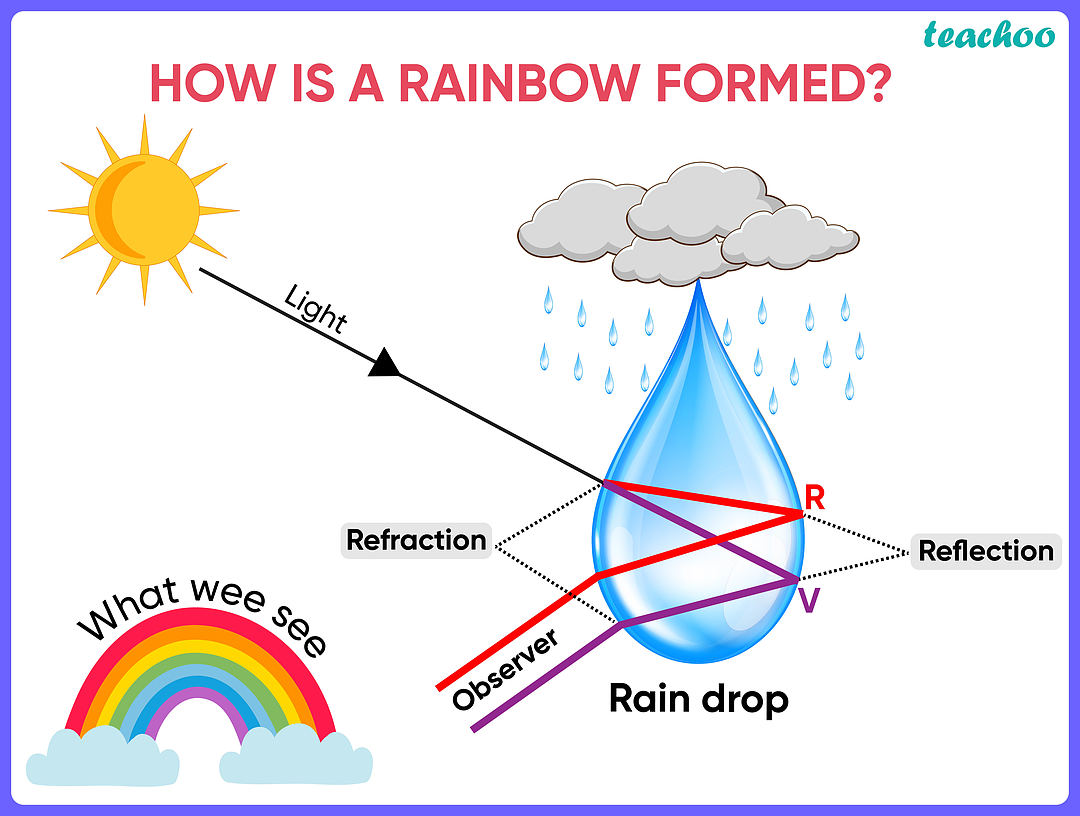
    How does a rainbow form?

    Rainbows form when sunlight passes through water droplets in the atmosphere, causing the light to refract, reflect, and disperse into the colors of the spectrum: Refraction: When light passes from air into a denser medium, like a raindrop, it changes direction. This is called refraction. Reflection:Read more

    Rainbows form when sunlight passes through water droplets in the atmosphere, causing the light to refract, reflect, and disperse into the colors of the spectrum:
    Refraction: When light passes from air into a denser medium, like a raindrop, it changes direction. This is called refraction.
    Reflection: The light reflects off the back of the raindrop.
    Dispersion: The light disperses into the seven colors of the spectrum.
    For a rainbow to appear, the sun, raindrops, and the observer must be in the right positions:
    The sun must be behind the viewer.
    The sun must be low in the sky, at an angle of less than 42° above the horizon.
    Rain, fog, or some other source of water droplets must be in front of the viewer.
    Rainbows appear semi-circular over level ground at sunrise or sunset. When viewed from the air, rainbows form a complete circle.

    See less
      • 0
    • Share
      Share
      • Share on Facebook
      • Share on Twitter
      • Share on LinkedIn
      • Share on WhatsApp

Sidebar

Select Language

Scan the QR below to find us on Play Store!
Qukut
Ask A Question
Add A New Post
Add A Group

Top Performers of the Month

Wallanza Wallpaper

Wallanza Wallpaper

  • 14 Points
Beginner
gazeboprinting

gazeboprinting

  • 12 Points
Beginner
redmondoutdoor

redmondoutdoor

  • 10 Points
Beginner
Pankaj Gupta

Pankaj Gupta

  • 4 Points
Scholar
  • Popular
  • Answers
  • Tags
  • Aditya Gupta

    Which skill is needed in future??

    • 6 Answers
  • Aryan Shukla

    What is Nested Class in Java?

    • 4 Answers
  • Pankaj Gupta

    Reference of Vattakirutal on Sangam Poem

    • 4 Answers
  • Pankaj Gupta

    What are classical languages in India?

    • 4 Answers
  • Anonymous

    How to share Qukut?

    • 3 Answers
  • Pankaj Gupta
    Pankaj Gupta added an answer The Low-Altitude Missile Defense (LAMD) is an indigenous interceptor system… March 15, 2026 at 10:46 am
  • Pankaj Gupta
    Pankaj Gupta added an answer The public administration of the Gupta period (4th–6th century CE)… March 8, 2026 at 1:55 pm
  • Pankaj Gupta
    Pankaj Gupta added an answer The Curiosity rover is one of NASA’s most advanced robotic… February 15, 2026 at 9:34 pm
  • Pankaj Gupta
    Pankaj Gupta added an answer India’s decision to include caste enumeration in the upcoming national… February 4, 2026 at 11:34 pm
  • Pankaj Gupta
    Pankaj Gupta added an answer Soft skills are developed through deliberate practice, self-reflection, and consistent… February 4, 2026 at 11:08 pm
#anatomy #discovery #invention 0) 0) in java accelerometer accountancy adhd agriculture agriculture sector ahimsa ai ai content ai content generators air pollution alphafold2 anaemia mukt bharat strategy animals annotation in heat map anthropology applications of fluid mechanics aquaculture system architecture article 335 artificial intelligence artificial intelligence in fintech art of india atmosphere attention-deficit/hyperactivity disorder authors automotive ayurveda banking basic rules of badminton for doubles benefits of online education bhagavad gita bharat ratna bharat stage vi biodiversity biofilters biology biosystematics biotechnology black magic blockchain bollywood books boolean algebra botany box office brain rot branches of physics british governor-general bsvi buddha buddhism buddhist center buddhist circuit building foundations business calabrian chiles carbon markets cards career cats cfd chain-of-thought chatgpt chola empire christmas cibil civil engineering class classical language climate change clock coaching for affluent cobalt cobalt production coffee cold-start data combinations commerce community development community reserve components of neural network computational fluid dynamics concept of scarcity confucianism congo basin constitution constitutional amendment in india constitutional bodies constitutional bodies in india constitution of india contingent risk buffer coping core beliefs of zoroastrianism corr() cricket crispr critiques of social contract theory crop rotation benefits cultural cultural diversity cultural heritage culture curiosity rover custom printed gazebo dams dark matter dead sea scrolls and judaism deciduous trees deepseek deepseek r1 deepseek r1 zero deforestation delhi dhanyakataka diesease differentiation different types of strokes in swimming dinosaur direct biodiversity values doctrine of lapse dogs double-entry bookkeeping double century dunning-kruger effect ecological benefits of water hyacinth economics economy ecosystem education effects of globalization on culture electrical engineering entertainment envionment environment eq eucalyptus exams existentialism existential nihilism festivals of buddhism finance finance bil find the missing term in the series find the next term in the series fintech first war of indian independence first woman to win a nobel prize fitness five pillars of islam floods food freestyle vs greco-roman wrestling function overloading functions fundamental techniques used in archery ganga ganges river gender general awareness geography gloabl trade agreements government gps fleet tracking australia gps tracking sydney green hydrogen green revolution green taxonomy gudimallam shiva lingam haka haunted health health scheme healthy heat map higgs boson hills in india himani mor hinduism history homo sapiens horizontal tax devolution human evolution humans ilmenite impact of deforestation impact of movie rating impact of organic farming on soil impact of social media on society impact of surface in tennis impact of sustainable fashion implicit type casting importance of cultural heritage india indian cities indian constitution indian independence act indian ocean indian philosophy indianpsychology indian squirrels india vs china indirect biodiversity values indoor plants indus valley civilization influence of pop culture inheritance innovations inspiration insurance plan for pets intermittent fasting international relations interpersonal skills coaching interrogatory words invasive species investments iq iron dome is artificial intelligence good for society islam islands isro it consultancy sydney it consulting sydney jainism jainism and non-violence jain practices jal satyagraha janani suraksha yojana java java code kanishka kinetic energy kmap korkai lake lamd language law lesser-known destinations in europe lidar life coach palm beach life coach west palm beach lifelessons lingam literature long distance running machine learning madhubani art mahasanghikas map marine ecosystem marketing markets marshlands marsupials mauryan empire meaning of life medical science medicine mensuration mercury pollution mesolithic meta meta's open-source strategy in ai metaverse microorganisms mindexpansion mineral water missing number missing numbers mixture of experts modern architecture money bill movie ratings muchiri mushrooms names of planets nasa natural disaster nature neeraj chopra neolithic nested class nested class vs inheritance neural network next() nextline() next number in the sequence niger (guizotia abyssinica) nitrogen narcosis nobel peace prize noise pollution nuclear power nuclear weapons ocean pollution off side rule in rugby oilseeds online education open source operation sagar bandhu organization oztrail deluxe printed gazebo oztrail gazebo printing australia paleolithic paramedical parenting pcb pcv personality pets philosophy physics plants polity poll pollutants pollution pollution grap restrictions poltics poompuhar ports of india portuguese post independence predestination prehistory preparing for long-term travel president of india primary amebic meningoencephalitis principles of constitutional law prison in india probability products propaganda movies psychology python quantum computing quantum entanglement question questions ramanujacharya ratan tata reality counselling reasoning recyclability of carbon fibres red fort reforms regional art relationship relationship counseling west palm beach religion republic reserve bank of india revolution road connectivity in india robusta role of the pope in catholicism rutile sanchi stupa sand volcanos satyamev jayate scanner scheduled areas schools of hinduism and karma science scoring system in swimming seaborn selfimprovement self respect shinto rituals and practices sikhism and equality skills smallest small farmer large field soccer social social change and technology social contract theory society soil soil pollution solo travel south india space science sport strategies in curling studytips stupas substring substring(0 sufism sustainable architecture sustainable design sustainable fashion swadeshi movement syllogism tactical fouling taenia solium tao te ching and taoism taxonomy technique for successful javelin throw techniques used in figure skating technology tedtalks theory of relativity therapist in palm beach therapist west palm beach tibetan vs theravada buddhism tools travel trend type of dinosaur types of building foundations types of chemical bonds unicode space unops s3i initiative investment upsc upsc phd upsc pre 2023 uranium uses of hydrofluorocarbons valueerror vattakirutal vehicles vijayanagara empire village of india virus vitamin d water water hyacinth water management water pollution western west palm beach therapist wetlands what is green house effect? whitespace wife of neeraj chopra wildlife yom kippur zen buddhism zoology zoroastrianism

Explore

  • Questions
  • FAQs
  • Points & Badges
  • Qukut LMS

Footer

Qukut

QUKUT

Qukut is a social questions & Answers Engine which will help you establish your community and connect with other people.

Important Links

  • Home
  • Blog
  • About Us

Legal Docs

  • Privacy Policy
  • Terms and Conditions

Support

  • FAQs
  • Contact Us

Follow

© 2024 Qukut. All Rights Reserved
With Love by Qukut.