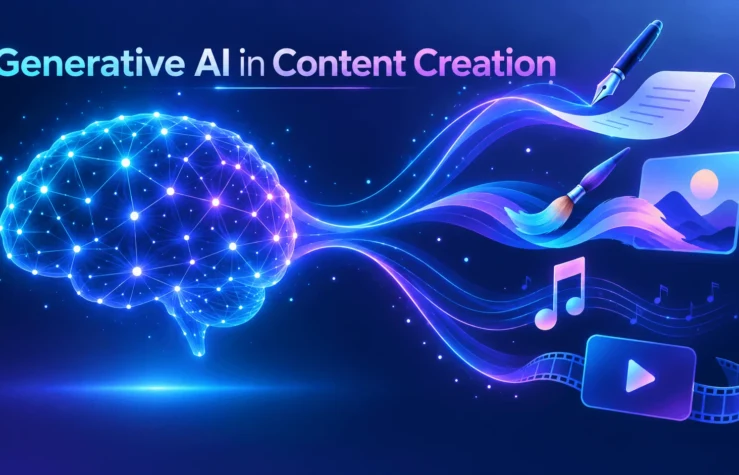
A few years ago, “content creation” meant a writer staring at a blank document, a designer starting from a blank canvas, or a video editor sifting through hours of raw footage to shape into something watchable. Today, a growing share of that first draft — the headline, the illustration, the background music, even the rough cut of a video — can be generated in seconds by an algorithm. Generative AI hasn’t replaced the creative process, but it has fundamentally rewired where that process begins, who participates in it, and how fast an idea can travel from concept to finished piece.
This shift touches nearly every industry that produces content for a living: marketing agencies, newsrooms, e-commerce brands, game studios, film and music production houses, and millions of independent creators. Understanding how the technology actually works — not just what it can produce — is the first step to using it well.
What Makes Generative AI Different
Earlier waves of “smart” software could sort, recommend, and predict. A recommendation engine could tell you which article you’d probably click next; a spam filter could predict which emails were unwanted. Generative AI does something categorically different: it produces original output — text, images, audio, video, or code — that didn’t exist before the prompt was typed.
Large language models (LLMs) learn the statistical patterns of human language from enormous bodies of text — books, articles, code, conversations — and use those patterns to predict, word by word, what a coherent and contextually appropriate continuation of a piece of text should look like. Given enough scale and training, that simple prediction mechanism becomes powerful enough to write essays, hold conversations, summarize documents, and explain complex ideas in plain language.
Image and video models work on a related but distinct principle. Many are built on “diffusion” techniques: the model starts with random visual noise and gradually refines it, step by step, into a coherent image that matches a text description or reference image, guided by patterns it learned from millions of labeled images during training. Audio and music models apply similar logic to sound waves and musical structure, learning what makes a melody, a voice, or a rhythm sound “right” and then generating new examples that fit those learned patterns.
The important distinction here is that these systems aren’t retrieving or splicing together existing content, the way a search engine or a collage might. They’re generating statistically plausible new content based on patterns learned during training. That’s precisely why they’ve become so useful — and so disruptive — across creative industries: the output feels novel, even though it emerges from patterns in existing work.
A Brief History of How We Got Here
Generative AI’s sudden visibility can make it feel like it arrived overnight, but the underlying research stretches back decades. Neural networks capable of generating text existed in limited forms as early as the 1990s and 2000s, but they were narrow, unreliable, and impractical outside research labs. Two developments changed that trajectory.
The first was the transformer architecture, introduced by researchers in 2017, which gave language models a far more efficient way to track relationships between words across long stretches of text. This unlocked models that could generate longer, more coherent, and more contextually consistent output than anything that came before.
The second was scale. Once researchers discovered that model performance improved predictably as they trained larger models on more data with more computing power, an arms race began. The result, over just a few years, was a leap from chatbots that could barely hold a coherent conversation to models capable of writing publishable prose, generating photorealistic images from a sentence, and producing serviceable code from a plain-language description. What used to be a research curiosity became, almost overnight, a mainstream productivity tool.
Where It’s Already Reshaping Content Creation
Writing and copy
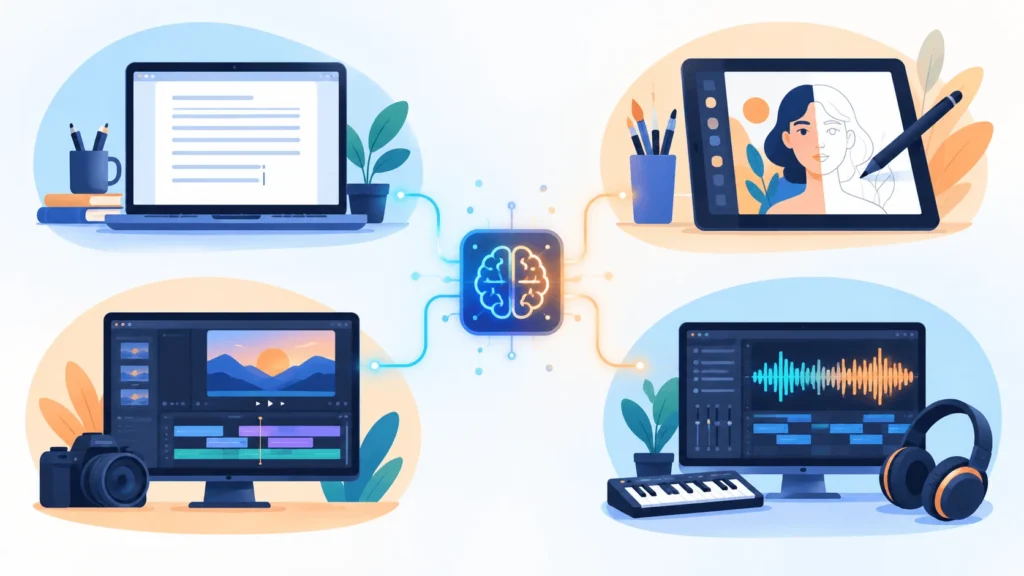
Marketing teams use generative models to draft product descriptions, social captions, email sequences, ad variations, and SEO-oriented blog posts at a pace no human team could match working alone. A retailer with 50,000 SKUs, for instance, can generate a first-pass product description for every item rather than leaving half of them blank or copy-pasted from a manufacturer’s spec sheet. Journalists use these tools to summarize lengthy documents, generate story outlines, draft interview questions, and translate content across languages for international editions. Novelists and screenwriters increasingly use AI as a brainstorming partner — a way to generate alternate plot directions or dialogue options to react against, even when none of the generated text survives into the final draft. In each case, the technology hasn’t eliminated writers so much as changed their role from sole author to editor-in-chief of AI-generated drafts.
Visual design
Image-generation tools let designers produce concept art, mood boards, packaging mockups, and marketing visuals from a simple text description, compressing what used to take hours of stock-photo searching or manual illustration into minutes. Brands increasingly use these tools for rapid prototyping — testing a dozen visual directions before committing a human designer’s time and a client’s budget to the one that resonates. Independent creators without design training can now produce passable logos, social graphics, and thumbnails that would previously have required hiring a freelancer.
Video and audio
AI-generated voiceovers, background scores, and even fully synthetic video avatars are now common in corporate training material, localized advertising, and short-form social content. A company can produce a training video narrated in fifteen languages without booking fifteen voice actors. Podcasters use AI to clean up messy audio, generate show notes and transcripts, and repurpose a single long-form episode into dozens of short social clips automatically. Film and game studios are experimenting with AI-assisted visual effects, background music generation, and even de-aging or dubbing actors’ voices for international releases.
Code and technical content
Documentation, sample code, tutorials, and even entire small applications can now be scaffolded through generative tools, blurring the line between “content” and “software” as a category of creative output. Technical writers use AI to draft API documentation from code comments; developers use it to generate boilerplate so they can focus on the genuinely hard problems.
Personalization at scale
Perhaps the least visible but most commercially significant use case: generative AI allows content to be tailored to individual users automatically. An email newsletter can generate a slightly different subject line and intro paragraph for thousands of subscriber segments. A streaming service can generate a unique thumbnail description or promotional blurb tuned to what it knows a given viewer responds to. This kind of personalization was technically possible before, but the cost of producing enough unique variations made it impractical outside the largest companies. Generative AI collapses that cost.
The Real Value: Speed, Scale, and Iteration
The most consistent benefit reported by teams adopting generative Artificial Intelligence isn’t quality — it’s velocity. A single marketer can now produce ten variations of an ad headline and test them all before lunch. A small business with no design budget can generate a passable logo concept in an afternoon. A solo content creator can maintain a publishing cadence that used to require a small team.
This matters most for organizations operating at scale: e-commerce sites needing thousands of unique product descriptions, media companies producing region-specific versions of the same story, or startups that need a professional web presence without a professional design budget. Generative AI turns content production from a linear, bottlenecked process into something closer to a search — generate many options, then select and refine the best ones. That shift from “produce one thing carefully” to “produce many things quickly and curate” is arguably the single biggest change to creative workflows in a generation.
It also lowers the barrier to entry for creative work generally. A person with a strong idea but no illustration skills, no video editing experience, or no formal writing training can now produce something presentable enough to test in the market. That doesn’t replace deep craft, but it does mean more ideas get a chance to be tried before someone decides whether they’re worth investing real expertise in.
The Limits Nobody Should Ignore
Generative AI’s fluency creates a trap: output that sounds confident and well-formed is not the same as output that is accurate, original, or good. Language models can state incorrect facts with total conviction — a failure mode often called “hallucination,” where the model generates a plausible-sounding but false statement because it is optimizing for statistical likelihood, not truth. Image models can produce visually impressive but anatomically or logically inconsistent results — a hand with six fingers, a shadow falling the wrong direction, text rendered as gibberish. Neither type of system has genuine understanding of truth or physical reality; they’re producing what’s statistically likely to follow from the prompt, not what’s verified to be correct.

There are also open and unresolved questions around originality and rights. Because these models are trained on existing human-created work — often scraped from the public internet without individual permission — questions about copyright, attribution, and fair compensation for the artists, writers, and photographers whose work shaped the training data remain the subject of active lawsuits and pending legislation in multiple countries. Content teams adopting these tools need to think carefully about licensing terms, disclosure obligations, and how they credit — or avoid infringing on — the work these systems learned from. This is a genuinely contested area, and the legal landscape is likely to keep shifting for years.
Finally, there’s a brand and audience-trust risk in over-reliance. Content that reads as generic, formulaic, or subtly “off” is increasingly easy for audiences to spot, and audiences are growing more skeptical of anything that feels mass-produced rather than genuinely considered. Search engines and social platforms have also begun adjusting their ranking and moderation systems to account for a flood of low-effort Artificial Intelligence-generated content, meaning that quantity without quality can actively hurt visibility rather than help it.
What Good Practice Looks Like
The organizations getting the most value from generative AI, without the associated risks, tend to follow a few consistent principles:
- Treat AI output as a first draft, not a final product: Human review for accuracy, tone, and brand voice remains essential at every stage.
- Fact-check anything factual: Never publish AI-generated claims, statistics, dates, or quotes without independently verifying them against a reliable source.
- Use it for volume and speed, not for your most important, brand-defining work: A hero video, a flagship campaign, or a signature piece of writing still benefits from dedicated human craft and a genuine point of view.
- Be transparent where it matters: Audiences increasingly appreciate knowing when Artificial Intelligence played a significant role in producing what they’re seeing, and some jurisdictions are beginning to require disclosure for Artificial Intelligence-generated media, particularly in advertising and political content.
- Keep a human point of view at the center: The strongest content, Artificial Intelligence-assisted or not, still comes from a genuine perspective and real expertise, not just a well-phrased average of everything the internet has already said on a topic.
- Build a review process, not just a generation process: The organizations that struggle with AI content are usually the ones that skipped the editing step, not the ones that used the tools in the first place.
Where This Is Heading
Generative AI in content creation is still early, even though it can feel ubiquitous already. Models are getting better at maintaining factual accuracy, respecting brand style guides, generating longer and more coherent work with less human correction needed, and producing multimedia content — text, image, video, and audio together — from a single unified system rather than a patchwork of separate tools.
The likely trajectory isn’t AI replacing creative professionals, but a redefinition of the job itself — shifting human effort away from first-draft production and toward direction, judgment, editing, strategic thinking, and the parts of creative work that require taste, context, and accountability that a model cannot supply on its own. The people and organizations that benefit most from this shift will be the ones that use these tools to do more creative work and explore more ideas, not to do less creative thinking.
The tools will keep improving. Whether that improvement translates into better content for audiences will depend less on the technology itself and more on how thoughtfully the people using it choose to apply it.